by lspeed | Oct 11, 2026 | Uncategorized
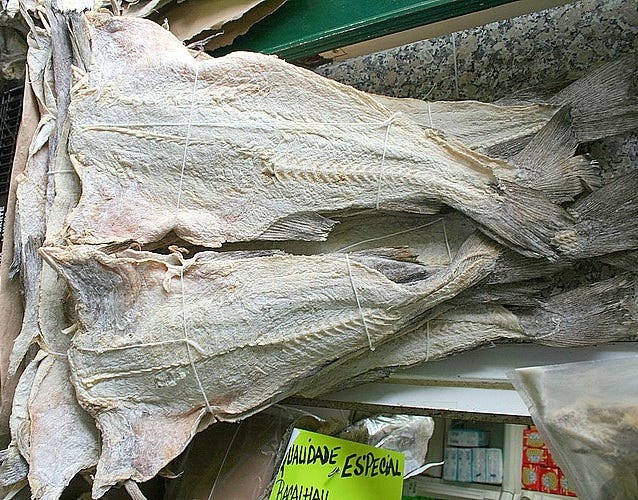
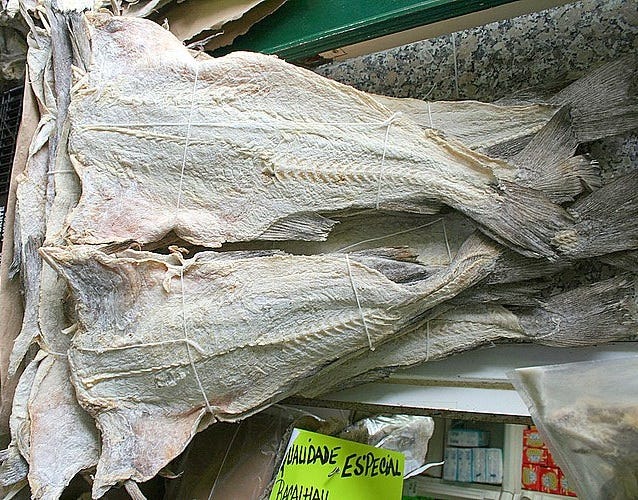
BACALAO: HOW SALTED COD CONQUERED THE WORLD
To us as restaurant owners, nothing is more important than freshness. We buy vegetables daily, make our sauces from scratch, and insist that all our imported meats arrive deep-chilled rather than frozen. We have occasionally sent entire beef deliveries back because we could tell they had been frozen before they arrived, even if it meant that some menu items would be unavailable for the day. So we find it kind of hilarious that one of the enduring culinary traditions of the Latin world is built around a fish that conquered half the world precisely because nobody needed it to be fresh.
Salt cod began as dire necessity rather than brilliant gastronomy. The North Atlantic was full of cod, but many people who wanted to eat it lived thousands of kilometres away. Norse cultures dried cod into stockfish that would last for months, and traders relied on salt for preservation. Religion then provided a massive marketing boost, because Catholics observe so many meatless days, particularly Fridays and Lent. A fish able to survive a long journey and sit patiently in a storeroom was both useful and valuable.
Nobody seems quite sure where the name of this peculiar dried fish comes from. One theory is that the word is related to the Dutch kabeljauw (cod), with the sounds of the word adapted as it travelled south to the Iberian Peninsula. Another suggests it may come from the Latin baculum, meaning stick, because dried cod is as stiff as one. Culinary history is full of such linguistic migrations and contortions, but in the end it’s all about taste and acceptance.
Venice turned it into baccalà mantecato, a Venetian menu mainstay, by working the soaked fish with olive oil until pale and almost mousse-like, then serving it on polenta or crostini. Further inland in Vicenza, bacalà alla vicentina is cooked slowly with onions, anchovies, olive oil and milk until soft and rich. Confusingly, both cities use the word baccalà for dried stockfish, while other Italians use it for salt cod. We don’t get involved, because one of our owners is Italian, and know better than to referee them about food.
Portugal took the relationship further than anyone. Its fishermen sailed as far as Newfoundland in search of cod, and bacalhau became central to the national kitchen. Hence the famous claim of 365 recipes, one for every day of the year. Spain developed its own formidable tradition, including the Basque bacalao al pil-pil, where cod, garlic and olive oil are gently worked together until the fish’s natural gelatin emulsifies with the oil to create a thick, silky sauce. With so few ingredients, there is nowhere for the cook to hide, which is why chefs have so much respect for it.
The fish eventually crossed the Atlantic, but for much less romantic reasons. Salt cod became an important food in the Caribbean plantation economy, including as provisions for enslaved workers. Over time, it was absorbed into local cooking, and Jamaica’s ackee and saltfish became the national dish. Other expressions, like bacalao guisado, combine shredded cod with tomatoes, peppers, onions, olives and capers. A preservation method developed around the cold North Atlantic had found an entirely new tropical life in the Caribbean.
South America embraced it too, most obviously in Brazil, where Portuguese colonisation brought the bacalhau tradition across the Atlantic. It remains closely associated with Christmas, Easter and family celebrations. Brazilians bake it with potatoes, onions, peppers, olives and plenty of olive oil, and turn it into casseroles and bolinhos de bacalhau, crisp little salt-cod fritters that quickly disappear at parties. Elsewhere on the continent, particularly in countries with strong Spanish and Portuguese influence, salt cod appears in stews, empanadas and Easter dishes.
As a South American steakhouse, we have occasionally debated adding it to the menu. So far the answer has been no, because anything that needs days of soaking before cooking would lead to a mass kitchen staff exodus. And we are a steakhouse, after all. But we have enormous respect for an ingredient that travelled from the North Atlantic to Italy, Iberia, the Caribbean and South America, changing character wherever it landed.
Sometimes, freshness isn’t everything.
Image Credit: https://en.wikipedia.org/wiki/Dried_and_salted_cod
_ _ _
© CHURRASCO PHUKET STEAKHOUSE / ALL RIGHTS RESERVED
Reprinting, reposting & sharing allowed, in exchange for a backlink and credits
Churrasco Phuket Steakhouse serves affordable Wagyu and Black Angus steaks and burgers. We are open daily from 12noon to 11pm at Jungceylon Shopping Center in Patong / Phuket.
We are family-friendly and offer free parking and Wi-Fi for guests. See our menus, reserve your table, find our location, and check all guest reviews here:
https://ChurrascoPhuket.com/
#Churrascophuket #jungceylon #phuketsteakhouse #affordablewagyu #wagyu

by lspeed | Oct 4, 2026 | RESTAURANT BUSINESS: BEHIND THE KITCHEN DOOR
Waiter, there’s an algorithm in my soup
Call me old-fashioned, but am I the only one who thinks the restaurant trade is heading down the wrong road? On a recent visit to our favourite Japanese restaurant in Singapore, I noticed that the printed menu had been replaced by an iPad that guests scroll through and order from. When asked, the staff did take our order the traditional way, though not with what I would call much enthusiasm.
I was not impressed, and this is not an isolated case. The same thing is happening in thousands of restaurants, especially in places like Singapore where labour is expensive and hard to find. It raises the question of why restaurants are so keen to introduce technology in the one spot where it does the most damage, directly between the guest and the service? Where it takes something very important away from the experience instead of adding to it.
And aren’t guests supposed to be at the heart of what we do?
At Churrasco Phuket Steakhouse, we continue to use oversized, leather-bound menus, and our staff take every order personally at the table. Technology only comes in after that. Our team enters the order into a mobile phone connected to our POS, which sends it straight to the kitchen and bar printers. The data then feeds into our AI system, to be used to analyse order flow, menu performance, and guest behaviour.
It is guest-facing, friendly and simple, but also fast and efficient. More importantly, our guests feel well looked after, and they don’t have to do what we consider our own job. That job, as I see it, is not selling food and drinks but making people happy, even if only for a few hours. Which is really what hospitality means to us.
Having got that off my chest, we welcome AI, as it does help us in many ways. It just belongs behind the scenes rather than in the guest’s face. Here are the areas where it has made a real difference in our operation without annoying anyone.
1. Purchasing and Stock Control
AI can look at past sales, reservations, weekdays, holidays and seasonal patterns to forecast what we are likely to need. This matters most with expensive fresh products. Order too much and you pay for it in waste, order too little and you either lose sales or end up buying at retail prices from the supermarket around the corner. AI won’t eliminate either problem, but it takes a lot of the gut guesswork out.
2. Staff Scheduling
Matching staff levels to business has always been difficult, even more so for a seasonal restaurant like ours, located in one of the world’s busiest tourist destinations. Guest numbers swing hugely over the year in Phuket, and our system analyses historical turnover, reservations and hourly sales to predict how many kitchen and service staff we will need.
We as owners and senior managers still decide the roster, but the system only knows how busy last Tuesday was and how busy the same Tuesday was in previous years. What it doesn’t know is which waiter can comfortably handle eight tables, and which one starts looking lost at four.
3. Menu Analysis
Because we are in such a high-traffic location and our guests change almost every week, weekly or monthly specials don’t do much for us. Instead, we fully update the menu once a year and launch it on an auspicious day with a fair amount of fanfare. That makes it important to look very carefully at the past twelve months, and with a 12 month horizon ahead of it. What sells, what doesn’t, what needs repricing, and what needs to come off.
We used to do this the hard way, working through long sales reports, cost sheets and everything else that comes with the job. Our POS already held most of the information, but AI can now compare sales volume, food cost, selling price and margin in minutes and show which dishes aren’t pulling their weight.
This year we did our first full menu analysis with AI. It saved us an enormous amount of time, and it also spared us the chef-versus-owner arguments every restaurateur knows too well. Every menu carries a few dishes that stay on longer than the numbers justify, and numbers are hard to argue with. Our chef was fully on board this time, and we all expect to both save and make more money as a result.
4. Routine Guest Enquiries
AI handles repetitive questions well. Opening hours, directions, parking, dietary options and basic reservation questions can be answered automatically on websites and messaging platforms, and in several languages, which is a real advantage in a place like Phuket. The more complicated questions are still our job, and they will stay that way.
5. Analysing Guest Feedback
We receive reviews and comments on several platforms, and which ones matter keeps shifting, especially with guests from more than 100 countries. Google is strong almost everywhere, Chinese guests check Dianping instead, and as a result of its arrogant past dealings with restaurants, Tripadvisor has lost much of the influence it once had.
AI can read through large numbers of reviews and pick out recurring themes. If complaints about waiting times are rising, management needs to know. If guests keep praising a particular dish or staff member, that is worth knowing too. One angry review may mean very little, but several mentioning the same issue should set off alarm bells.
Don’t Get Me Wrong
Clearly, AI is here to stay and has enormous potential for restaurants, but just not with a seat at the table. We use it to forecast demand, analyse costs, plan staffing, answer routine questions and understand feedback – all of it behind the scenes.
When guests arrive though, they get a cold towel and a menu, their order is taken with a smile, and we make sure that nobody leaves unhappy. Maybe that will look even more old-fashioned in ten years, and maybe some younger guests already prefer tapping on a screen.
I honestly don’t know. But for now, we are hospitality professionals. Not IT vendors.
Image Credit: https://www.churrascophuket.com (AI Generated)
_ _ _
© CHURRASCO PHUKET STEAKHOUSE / ALL RIGHTS RESERVED
Reprinting, reposting & sharing allowed, in exchange for a backlink and credits
Churrasco Phuket Steakhouse serves affordable Wagyu and Black Angus steaks and burgers. We are open daily from 12noon to 11pm at Jungceylon Shopping Center in Patong / Phuket.
We are family-friendly and offer free parking and Wi-Fi for guests. See our menus, reserve your table, find our location, and check all guest reviews here:
https://ChurrascoPhuket.com/
#Churrascophuket #jungceylon #phuketsteakhouse #affordablewagyu #wagyu

by lspeed | Sep 27, 2026 | KNOWLEDGE: MEAT ESSENTIALS
I come from a family of hunters, and my father held two firm beliefs about it. The first was that tramping through the forest with his salvaged WWII Mauser 98k sniper rifle would make a man out of me. The second was that if you killed an animal, you ate every part of it, no excuses, no exceptions. It made rack of venison dinners at our house an ever elusive treat, while venison lung hash became the house speciality. I still get the cold shivers when I think back to those meals, with my dad making sure that my plate came back clean. Or else.
So I have sympathy for anyone who – like me – is confronted with haggis for the first time. The Scots took my father’s credo and did something he thankfully never managed – turning animal spare parts into a national icon. In my family, lungs were a test of character, whereas in Scotland they are honoured with bagpipes, a poem, and a night of the year all to themselves.
Scotland has given the world many universally liked things, like whisky, golf, penicillin, the Loch Ness monster, and Sean Connery. But when it comes to haggis, the culinary world gets quickly divided between horror and elation. The famous mixture of sheep’s heart, liver and lungs, plus oatmeal, onion, suet and spices, is traditionally packed into the animal’s stomach and simmered. When written down like this, it sounds rather less like dinner, and more like something the chef forgot to quietly dispose of.
Aficionados assure me that Haggis deserves a break, and lovingly describe it as savoury, peppery and surprisingly delicate. The oatmeal absorbs the meat juices and giving it a loose, almost crumbly texture, with the flavour being close that of a particularly good rustic stuffing. So they say.
Its origins are even murkier than its ingredients. Scotland claims haggis as its own, but cooking chopped offal with grain inside an animal’s stomach is far older than the national identity now attached to it. Similar preparations existed elsewhere, and rather awkwardly, an English manuscript from the 15th century contains a recipe for something called hagese.
Food historians are welcome to argue over ownership, but Scotland won the marketing battle centuries ago, thanks to a a food writer by the name of Robert Burns. His 1786 Address to a Haggis elevated a humble pudding into the “Great chieftain o’ the puddin’-race”. Every January 25, Burns Night gives Scots a reason to recite poetry, before cutting into their Haggis, accompanied by the sound of bagpipes.
That is considerably more ceremony than any sheep’s innards could have expected in life. It is served with Neeps and Tatties (turnip and potatoes), and not surprisingly often comes with a whisky sauce. The combination makes sense, earthy, rich and buttery, precisely the sort of food for weather in which nobody is booking a table on the terrace.
The original idea was so sound that it explains its longevity. Throwing away edible organs at slaughter was wasteful, and since offal spoils quickly, it was chopped, seasoned and cooked. Even the stomach had its job to do as a natural cooking vessel – much like sausages and their intestine casings. This was nose-to-tail eating centuries before anyone thought of opening a themed restaurant with the phrase on the menu. My father would have approved – minus the poetry probably – because food was too serious a serious matter for light entertainment.
In America, sheep lungs are banned for human consumption since 1971. The traditional recipe therefore cannot be used in its original form, and American haggis tends to arrive anatomically edited. There also are vegetarian and “gourmet” versions around, and haggis now pop up in everything from burgers to canapés. Purists will raise an eyebrow, but since haggis was born from practicality, not culinary refinement, it seems unfair to be so exclusive on its behalf.
So yes, I’ll raise a dram to this great Scottish culinary pastime. Whether I’ll ever eat it again though is between me, the bagpipes, and my dad’s ghost.
Image Credit: https://www.churrascophuket.com (AI Generated)
_ _ _
© CHURRASCO PHUKET STEAKHOUSE / ALL RIGHTS RESERVED
Reprinting, reposting & sharing allowed, in exchange for a backlink and credits
Churrasco Phuket Steakhouse serves affordable Wagyu and Black Angus steaks and burgers. We are open daily from 12noon to 11pm at Jungceylon Shopping Center in Patong / Phuket.
We are family-friendly and offer free parking and Wi-Fi for guests. See our menus, reserve your table, find our location, and check all guest reviews here:
https://ChurrascoPhuket.com/
#Churrascophuket #jungceylon #phuketsteakhouse #affordablewagyu #wagyu

by lspeed | Sep 20, 2026 | WINES: UNCORKING THE MYSTERY
Let me start by saying that I’m not at all a Champagne guy. I spent more than enough years in the luxury industry, getting the stuff handed to me at every product launch, gala, or mildly successful watch exhibition. It stopped tasting like celebration to me over time, but hospitality cannot function without it. Take Champagne away from galas and openings, and events turn into just a bunch of people standing around awkwardly, holding canapés and looking for the exit.
So, even as a sceptic, I have developed opinions. They are less about taste, or the provenance of one Maison or another, than about glassware. At the risk of sacrilege, I think almost everyone is drinking Champagne from the wrong type of glass, but with valid reasons. In my defense, iconic houses such as Krug have been making the same argument for years. I am in good company.
Start with the Champagne Flute, that tall, narrow, look-at-me-and-my-bubbles glass. It is elegant, photogenic and the default at every event with a dress code. It is also something of a scam. The shape does a splendid job of preserving and displaying the bubbles, but a less impressive one of letting you smell what you are drinking. There is little room for the aromas to develop. The brioche, nuts, citrus and that overused minerality thing wine people like to go on about are all there, but struggling to get a word in. The flute is not really built for tasting, but for looking good, which explains its enduring success.
Then there is the Champagne Coupe, the shallow, wide glass seen in every film that involves Gatsby, moody leading ladies in long dresses, or someone making regrettable decisions after midnight. Legend has it that its shape was modelled on Marie Antoinette’s breast, which it wasn’t, of course. But that story has proved considerably more durable than bubbles poured into it.
Called the Sektschale in Germany, the coupe remains the go-to vessel for the country’s sparkling wines. It is not an improvement on the flute, but arguably a worse choice. Its open surface allows bubbles to disappear quickly, so the sparkling part of the experience begins fading as soon as it is poured. It also spills the drink onto your tuxedo if you look the wrong way for a moment, and I’m speaking from experience here. The coupe is gorgeous but largely useless, rather like a supercar without trunk space.
So what actually works?
A plain white-wine glass, like the type you already own. Preferably a tulip-shaped one, with a wider bowl that narrows towards the top. It gives the wine room to breathe and the aromas somewhere to unfold before they reach your nose. You can swirl and sniff it as you would a Chablis or any other serious white wine. This is not as revolutionary a position as it sounds, and a growing number of sommeliers and Champagne houses start recommending much the same thing.
As always, there is a trade-off, as the bubbles will not last quite as long as they do in a flute. And some of that “look at these gorgeous bubbles, daaaaahling” theatre is lost. But if you actually want to taste the thing you probably paid too much for, the choice is easier than convention suggests.
Before reaching for a glass then, consider what you are trying to achieve. If you are toasting an engagement, take the flute. Nobody will be analysing tasting notes at that moment. If you want 1920s glamour and have less concern if the wine survives beyond minute three, take the coupe and get the cameras ready. But if you opened a serious vintage, or merely a bottle good enough to deserve some attention, reach for a tulip-shaped wine glass.
The three glasses are not competitors, but tools for different jobs. And Champagne, the hospitality industry’s perennial overachiever, has found a use for all three.
It’s complicated, darling. But then, so is the bubbly industry itself.
Image Credit: https://www.churrascophuket.com (AI Generated)
_ _ _
© CHURRASCO PHUKET STEAKHOUSE / ALL RIGHTS RESERVED
Reprinting, reposting & sharing allowed, in exchange for a backlink and credits
Churrasco Phuket Steakhouse serves affordable Wagyu and Black Angus steaks and burgers. We are open daily from 12noon to 11pm at Jungceylon Shopping Center in Patong / Phuket.
We are family-friendly and offer free parking and Wi-Fi for guests. See our menus, reserve your table, find our location, and check all guest reviews here:
https://ChurrascoPhuket.com/
#Churrascophuket #jungceylon #phuketsteakhouse #affordablewagyu #wagyu

by lspeed | Sep 13, 2026 | DECODING GRAPES: FROM VINES TO VINTAGE
During a recent lunch at a small Italian restaurant on Vietnam’s Mui Ne beach, I spotted the name Pecorino on the wine list of. Some Italian insider joke, or perhaps an overly enthusiastic wine-and-cheese promotion? Maybe a wedge of cheese had wandered onto the wrong page of the menu, after the owner had enjoyed a little too much vino himself?
As it turned out, Pecorino is not only the essential cheese for iconic pasts dishes like Carbonara, Amatriciana, or Cacio e Pepe. It also is an official and perfectly legitimate Italian white grape. And to make things more confusing, there is a actual sheep connection too. The variety is native to central Italy, particularly the mountainous territory straddling Marche and Abruzzo. Its name is thought to derive from Pecora, Italian for sheep.
One poetic explanation for the name is that shepherds moving through the mountains noticed the sheep had a taste for these particular grapes. Whether that is oenological history or rural folklore I don’t know, but it’s more entertaining than many creative grape-name stories out there.
Pecorino is an old grape variety. Small berries, thick skins and naturally low yields make it capable of producing concentrated wines with decent acidity. Unfortunately, “low yielding” are two words that make farmers reach enthusiastically for other grapes. By the 1970s, Pecorino was edging toward extinction, unable to compete economically with more productive varieties. By 2000, only about 87 hectares remained planted in all of Italy.
Its survival owes much to winemaker Guido Cocci Grifoni in Marche. In 1982, he tracked down surviving Pecorino vines, took cuttings and began experimenting with them at his estate. By 1990, Tenuta Cocci Grifoni released about 1,800 bottles of varietal Pecorino. Its Colle Vecchio became one of the benchmark labels for the reborn grape.
Across the regional border, Luigi Cataldi Madonna became the Pecorino champion of Abruzzo. His first wine appeared in the 1990s, and he was the first to put the grape’s name prominently on the bottle. This helped turn an obscure local curiosity into a recognisable and tradable variety.
Today, Pecorino is no longer endangered, thanks to marketing hype and social media. Its principal territories remain Abruzzo and Marche, with Offida Pecorino DOCG among its most important expressions. The revival is so successful that the danger is now be the opposite, meaning planting it in warmer, flatter sites just because the name sells. Pecorino’s natural home is cooler hillside and mountain country, where its combination of ripeness and acidity works best.
If you’re shopping for it, look for Tenuta Cocci Grifoni Colle Vecchio, Cataldi Madonna Frontone and Tiberio Pecorino. In the glass, expect a medium dry white with citrus and orchard fruit, restrained acidity and a bit of a saline finish. The good ones carry noticeably more body than the bottle I’ve tried, and apparently they age rather well too.
Which brings us back to that beach in Vietnam. I ordered it because the name made me laugh. But my personal verdict on the taste was – let’s say – measured. Fine for a light beachside lunch, and I’d order it again under the same circumstances of sun, sand, and restrained expectations. But hand me a top Soave Classico, or even a decent Pinot Grigio, any day of the week.
I like knowing what I’m getting, and getting what I ordered. Viva!
Image Credit: https://www.churrascophuket.com (AI Generated)
_ _ _
© CHURRASCO PHUKET STEAKHOUSE / ALL RIGHTS RESERVED
Reprinting, reposting & sharing allowed, in exchange for a backlink and credits
Churrasco Phuket Steakhouse serves affordable Wagyu and Black Angus steaks and burgers. We are open daily from 12noon to 11pm at Jungceylon Shopping Center in Patong / Phuket.
We are family-friendly and offer free parking and Wi-Fi for guests. See our menus, reserve your table, find our location, and check all guest reviews here:
https://ChurrascoPhuket.com/
#Churrascophuket #jungceylon #phuketsteakhouse #affordablewagyu #wagyu