
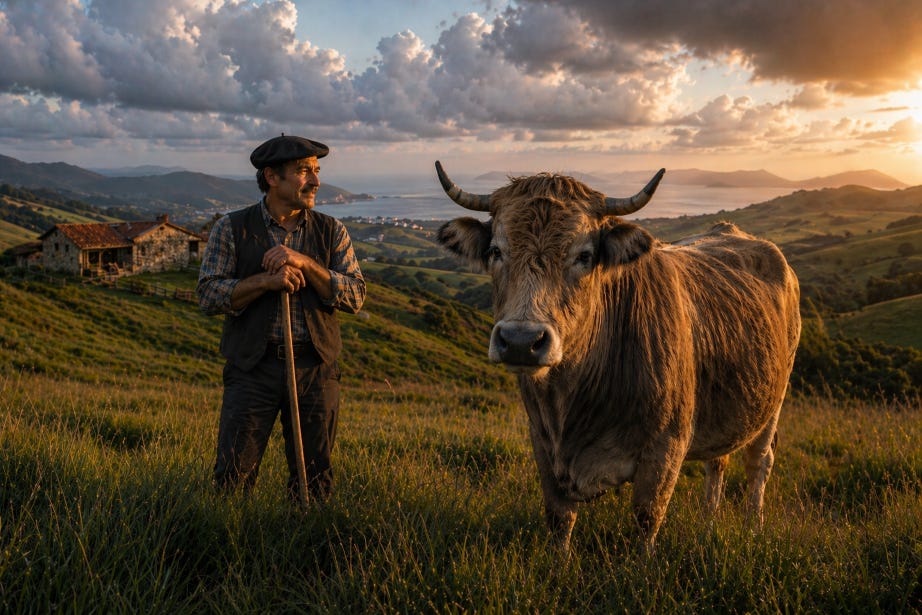
We don’t use it, and it has not exactly been lobbying for a place on menus around the world – ours included. But the term Vaca Vieja has a habit of sticking in the mind once encountered. It sounds like something disgruntled diners may mutter under their breath, yet in certain beef-obsessed circles it carries respect.
As it turns out, “old cow” is not an insult but a sign that things may get interesting. The story begins in northern Spain’s Galicia and Asturias regions, where cattle historically had long and productive lives before anyone considered turning them into dinner. These were working animals first and foremost which pulled, produced, and contributed. The idea that they should be eaten young and efficiently was seen as downright idiotic. Slaughter was not the starting point, but the epilogue.
Which brings us to the defining feature – Vaca Vieja refers to cows that have taken their time, often five to ten years, while most modern beef barely ever makes it past its second birthday. The result is not subtle, but shows up as meat that is darker, with much firmer texture, and flavour that arrives with a distinct point of view. There are nutty notes, mineral edges, and the suggestion that the animal has seen life and is not shy about it.
For a long time, this was not at all a premium pitch. Older animals were, quite sensibly, directed towards stews and slow cooking where patience would do the heavy lifting. Then, somewhere between curiosity and stubbornness, a handful of chefs and butchers looked at the situation and decided that perhaps the problem was not the meat, but the expectations placed upon it. Instead of trying to make the meat behave younger, they leaned into what it already was.
Restaurants such as Casa Julián de Tolosa and Asador Etxebarri began treating Vaca Vieja with care rather than caution. Proper ageing, careful butchery, and a confident hand with fire transformed it from an afterthought into something that commands attention. There is also a broader cultural thread running through all of this. Spanish food traditions tend to favour character over uniformity, and Vaca Vieja fits neatly into that philosophy. It sits comfortably alongside cheeses requiring consideration, cured meats that reward patience, and wines that are not constantly concerned with pleasing everyone at the table.
Today, Spain remains its natural home, but the idea has started to travel. Butchers and chefs in France, Italy, England, and amongst Latino communities in the United States have begun exploring the territory. The aim is not to chase tenderness at all costs, but to see what happens when flavour is given time to develop.
It does remain, by any measure, a niche, because older beef demands skill and a willingness to accept that it may not behave quite as expected. But that, arguably, is part of the appeal. Instead of smoothen things out, Vaca Vieja keeps a few edges intact.
In doing so, it reminds us that not all good things in life need to be easy.
Image Credit: https://www.churrascophuket.com (AI Generated)
_ _ _
© CHURRASCO PHUKET STEAKHOUSE / ALL RIGHTS RESERVED
Reprinting, reposting & sharing allowed, in exchange for a backlink and credits
Churrasco Phuket Steakhouse serves affordable Wagyu and Black Angus steaks and burgers. We are open daily from 12noon to 11pm at Jungceylon Shopping Center in Patong / Phuket.
We are family-friendly and offer free parking and Wi-Fi for guests. See our menus, reserve your table, find our location, and check all guest reviews here:
https://ChurrascoPhuket.com/
#Churrascophuket #jungceylon #phuketsteakhouse #affordablewagyu #wagyu