
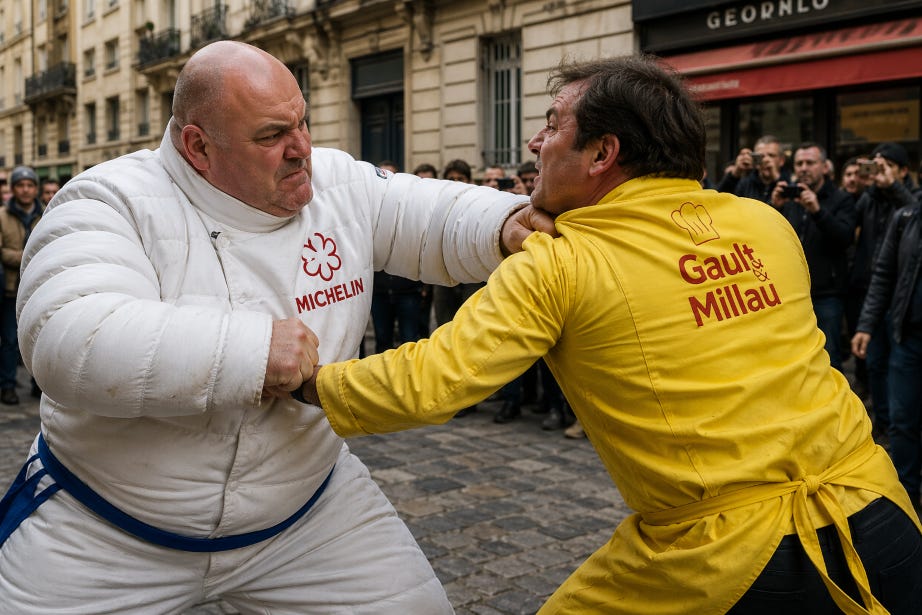
The restaurant guide world is a peculiar mix of tyre salesmen, rebel critics, anonymous inspectors, and nervous chefs overcooking their stress levels. At the centre of it all sit two enduring heavyweights: the Guide Michelin and Gault & Millau, locked in a decades-long disagreement about how best to judge your dinner.
Tyre giant Michelin did not set out to rule gastronomy, but simply wanted to get more cars on the road. Founded in 1900 by brothers André and Édouard Michelin, the Guide Michelin handed motorists maps, hotel listings, and the occasional place to eat, all in the hope that more driving would lead to more worn tyres. Somewhere along the way, diners began paying more attention to the food than the fuel stops. By 1926, stars appeared, and by 1931, the now-mythical one, two, three-star system was born. Today, earning a star can feel less like culinary recognition and more like being knighted, except the sword is replaced by a tasting menu and the ceremony happens without any fair warning.
Then came Gault & Millau in the late 1960s, looking at Michelin’s polished hierarchy and deciding it needed a bit of loosening up. Founded by Henri Gault and Christian Millau, two critics with a taste for disruption, it championed nouvelle cuisine, lighter sauces, shorter cooking times, and chefs who were encouraged to think rather than simply repeat. Where Michelin felt like a well-tailored suit, Gault & Millau arrived in something slightly more relaxed, collar open, ready to question the menu.
Their scoring systems mirror their personalities. Michelin is elegantly simple – up to three stars, no half measures, and no explanations beyond a few carefully chosen words. You are either in, or you are explaining to your investors why you are not. Gault & Millau prefers nuance, using a 20-point scale and awarding toques, allowing it to say – in effect – “very good, but perhaps rethink the sauce.” It is less thunderbolt, and more ongoing foodie conversation.
In terms of global clout, Michelin still carries the bigger spoon. Its expansion across Europe, Asia, and the Americas has turned it into a kind of culinary passport system. A star in Tokyo attracts a diner from Paris, a promotion will double bookings overnight, but a demotion can lead to an existential crises. And the occasional chef claiming they never wanted it anyway. Gault & Millau, meanwhile, enjoys a quieter authority. It is the guide chefs read when they want to know what other chefs really think, all in a less headline-grabbing, more kitchen-table discussion style.
Both insist on the same core rituals or anonymous inspectors, multiple visits, and a careful distance from the businesses they judge. Whether that distance always holds in a world of sponsorships, tourism boards, and global expansion is a question politely asked and rarely answered in full. What is clear is that both guides now operate in a dining landscape that has shifted dramatically under their feet. Casual concepts thrive, viral social media reviews travel faster than inspectors, and diners increasingly trust a well-lit photo over a discreet star.
They are no longer alone, either. The World’s 50 Best Restaurants offers a glossy, vote-driven ranking that feels part awards show, part culinary Eurovision. La Liste takes a data-heavy approach, compiling scores from across the globe to produce something resembling a gastronomic spreadsheet. And Zagat, the original voice of the crowd, reminds everyone that diners themselves have opinions, many of them loudly expressed.
In general, guides reveal less about food than about how much humans love to rank things. Michelin delivers verdicts, Gault & Millau offers commentary, and the rest provide noise, data, or spectacle. In the end though, nothing will ever replace the ultimate culinary verdict.
That of the guest.
Image Credit: https://www.churrascophuket.com (AI Generated)
_ _ _
© CHURRASCO PHUKET STEAKHOUSE / ALL RIGHTS RESERVED
Reprinting, reposting & sharing allowed, in exchange for a backlink and credits
Churrasco Phuket Steakhouse serves affordable Wagyu and Black Angus steaks and burgers. We are open daily from 12noon to 11pm at Jungceylon Shopping Center in Patong / Phuket.
We are family-friendly and offer free parking and Wi-Fi for guests. See our menus, reserve your table, find our location, and check all guest reviews here:
https://ChurrascoPhuket.com/
#Churrascophuket #jungceylon #phuketsteakhouse #affordablewagyu #wagyu