by lspeed | Mar 15, 2026 | RESTAURANT BUSINESS: BEHIND THE KITCHEN DOOR
In our restaurant, our Head Chef is, rather inconveniently for television producers, a calm and balanced person. During our peak seasons, he stands before a grill that behaves less like a cooking surface and more like a military operation. Three dozen steaks at once are fairly standard, sometimes more, each demanding its own treatment and precise moment of intervention.
A Rib Eye prefers the simplicity of medium rare. The next one has been ordered well done. A line up of Tenderloins insists on restraint, patience and widely differing cooking points, while one of our famous Picanhas rewards a decisive sear. Somewhere on the edge of the grill, a Skirt Steak waits to be sliced properly so that it ends up tender rather than obstinate.
Around him the kitchen and restaurant are boiling. Orders pile in, plates depart at second intervals, and the grill emits a steady soundtrack of sizzling fat and metre high flames. Yet our Chef rarely raises his voice. He flips, rests, bastes and checks with the quiet concentration of someone who understands that panic never improves a steak. This has been his pattern for well over a decade, which is precisely why we value him so highly.
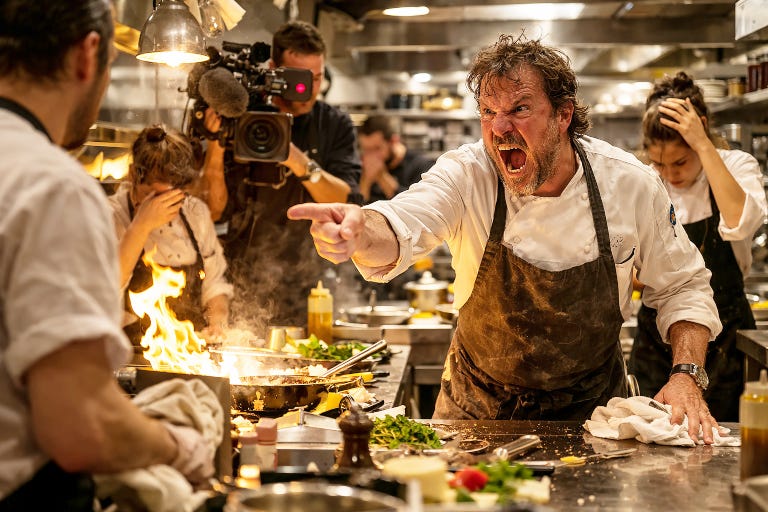
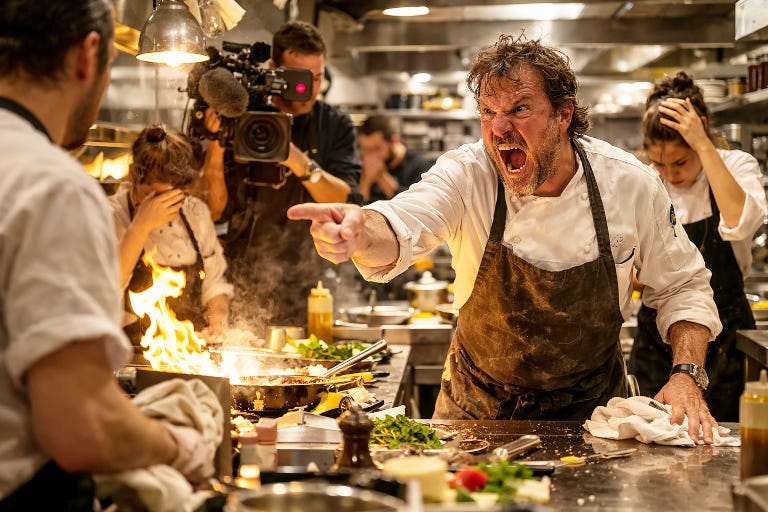
Unfortunately, calm chefs like him are often the exception. The restaurant industry has long cultivated a curious figure: the tyrannical head chef who believes culinary excellence is best enforced through shouting, intimidation and the occasional airborne utensil. In this particular mythology, precision thrives best in a climate of fear, and a soufflé rises more reliably if someone nearby is being loudly humiliated.
Television, naturally, has preserved and amplified this character. The most famous embodiment of the angry chef persona is undoubtedly Gordon Ramsay, who managed the impressive feat of transforming volcanic temper into a global media franchise. His television kitchens operate somewhere between cooking school and gladiator spectacle. Contestants tremble under verbal barrages, dishes are condemned with theatrical brutality, and viewers watch the drama unfold while safely seated on their sofas munching popcorn.
The phenomenon is by no means limited to male chefs, although it has also seen prominent female figures accused of similar behaviour. One of the more widely discussed examples involved April Bloomfield, the chef associated with New York’s once fashionable Spotted Pig. Former employees later described a workplace culture in which bullying and intimidation appeared to be part of the daily kitchen rhythm. The issue is therefore less about gender than about overall restaurant culture and leadership.
Which brings us to the latest chapter in this uncomfortable discussion, involving Copenhagen’s once legendary restaurant Noma and its celebrated founder René Redzepi. He has been accused by former staff of violence and intimidation, and of creating a workplace in which shouting, public humiliation and even physical aggression were allegedly common. One chef described going to work there as entering a war zone; another compared the atmosphere to a hospital emergency triage room.
To his credit, Redzepi has acknowledged that he struggled with anger and has spoken about seeking therapy to address his issues. The Noma organisation has also stated that the workplace culture today no longer resembles the one described in these accounts.
Even so, the broader debate within the restaurant industry is unlikely to disappear anytime soon. Running a high performance restaurant like ours, serving over 200 steak covers a night, is unquestionably stressful. Dinner service needs to unfold with the precision of choreography performed under fire. Guests expect perfection rather than explanations, and a steak cooked two minutes too long cannot be persuaded back to medium rare. Still, pressure does not justify abuse.
We as restaurant owners have always maintained that we carry the ultimate responsibility, not only for the quality of the food, but also for the culture in which it is produced. The notion that temper tantrums are a legitimate management strategy is one we have always rejected, and one the industry at large needs to retire.
From day one, we took a deliberately unfashionable and distinctly non TikTok approach. Rather than tolerating theatrical outbursts, we opted for something that would not look dramatic on television – communication. Every quarter or so, the kitchen and service teams sit down together for an open exchange of views and issues. The purpose is not to assign blame, but to identify what works during service, what creates friction, and what could be improved before the next busy season arrives. It is remarkable how many operational problems dissolve once people simply speak to one another like colleagues.
Following these sessions, we organise a complete day off for team activities chosen by the staff themselves. Sometimes it is a beach outing, sometimes dinner somewhere else, occasionally karaoke, games they select, or something entirely unexpected. We as owners help organise and cover the costs. Everyone attends, many with spouses or partners, not as rival departments but as members of the same successful enterprise.
It is, admittedly, not the sort of system that produces viral kitchen meltdowns, but for us it functions rather well. Our restaurant has been operating continuously since January 2012, and we suspect that this rather mundane emphasis on mutual respect between kitchen and service teams has contributed more to that longevity than any amount of shouting or media coverage ever could.
The culinary world will continue to produce stories of chefs throwing pans, berating apprentices or declaring war on failed plate designs. Meanwhile, our own kitchen remains quietly occupied with the more traditional task of cooking excellent steaks.
Three dozen at once, sometimes more. No shouting required.
Image Credit: https://churrascophuket.com (AI Generated)
_ _ _
© CHURRASCO PHUKET STEAKHOUSE / ALL RIGHTS RESERVED
Reprinting, reposting & sharing allowed, in exchange for a backlink and credits
Churrasco Phuket Steakhouse serves affordable Wagyu and Black Angus steaks and burgers. We are open daily from 12noon to 11pm at Jungceylon Shopping Center in Patong / Phuket.
We are family-friendly and offer free parking and Wi-Fi for guests. See our menus, reserve your table, find our location, and check all guest reviews here:
https://ChurrascoPhuket.com/
#Churrascophuket #jungceylon #phuketsteakhouse #affordablewagyu #wagyu

by lspeed | Mar 8, 2026 | RESTAURANT BUSINESS: BEHIND THE KITCHEN DOOR
In our business, reputation is not a side dish, but the main course. You can source the best produce, age your steaks to perfection, polish the glasses until they sing under the lights, and still find your week defined by a single paragraph written at midnight on a smartphone. That is the modern dining room. It extends far beyond your four walls and lives online, where star ratings quietly shape tomorrow’s reservations.
Online reviews are today’s word of mouth, only faster and less forgiving. Once published, they live on the Internet forever, because neither Google or Tripadvisor care if you survive or die. A strong run of positive feedback lifts a restaurant’s profile and builds momentum. A poorly handled negative review lingers like overcooked fish.
Reviews are not just commentary, they are public theatre. And how you respond is part of the daily show. This is where a simple mantra proves surprisingly effective: Smile, Apology, Gesture. It sounds almost too neat, but in practice, it is disciplined, professional, and remarkably powerful.
Smile: Stay Positive
When you read a negative review, especially one that feels unfair, your first instinct is not calm serenity. You may want to reach for blood pressure medication, or at least set the record straight. You want to explain that Saturday night was fully booked, that the kitchen was running at capacity, that the guest arrived forty minutes late and ordered extra well done Wagyu.
All of that may be true, but none of it belongs in your opening sentence. “Smile” does not mean ignoring problems, but choosing tone over temper. A measured, friendly response signals to everyone reading that you are composed and professional. It also tells future guests that you care enough to listen and engage.
Even harsh feedback contains information. Sometimes it reveals a genuine oversight, or at least it can show a perception gap between what you think you deliver and what guests experience. Public defensiveness rarely wins applause, but professional composure usually does.
Apology: Take Responsibility
An apology is not a legal confession, but an acknowledgment of someone’s disappointment. And there is a difference, especially in restaurants like ours with a prevailing mantra of “Nobody Leaves Unhappy”. Phrases such as “We are sorry to hear that your visit did not meet expectations” validate the guest’s experience without assigning blame, before facts are clear. The goal is not to argue details point by point, but to demonstrate empathy.
In hospitality, guest perception is your reality, fair or not. If a guest felt overlooked, rushed, or dissatisfied, that feeling is real to them, even if your views or the internal report reads differently. Avoid long explanations, blaming staff, suppliers, the weather, or other guests. A public reply is not the place for operational analysis, but a place for reassurance. A concise, sincere apology shows maturity, and shows that you understand the long game. Restaurants are built on trust, and that trust grows when guests feel heard and acknowledged.
Gesture: Make It Right
The final step is action. Words set the tone, but a gesture rebuilds the bridge, and this does not always require a grand offer. Sometimes a personal invitation to return and experience the restaurant again is enough. Sometimes a complimentary course, a discount, or a direct line to management makes sense.
The key is relevance. If the issue was slow service, mention that improvements have been implemented and invite the guest back to see the difference. If a dish disappointed, offer to prepare it personally next time. Specific gestures signal accountability, and show that the response is not templated but considered and thoughtful.
At the same time, gestures must be sustainable, because restaurants don’t survive by giving away the dining room every time someone complains online. The ultimate aim is not to reward negativity, but to demonstrate fairness and goodwill.
Life Beyond The Damage
Handled correctly, a negative review can actually strengthen your reputation. Prospective guests often read the worst reviews first, wanting to see how you react under pressure. A composed, empathetic, solution focused response can turn a potential liability into evidence of professionalism. Positive reviews deserve attention too. Engagement suggests pride. Thanking guests publicly reinforces loyalty and encourages repeat visits. Silence, by contrast, suggests indifference.
Every plate leaving the kitchen carries expectation. And every review, glowing or critical, offers a chance to refine your craft and public face. So even if it’s difficult sometimes, do the “Smile, Apologise & Make a Gesture” routine. In the restaurant world, reputation served daily, with every reply having to be as carefully considered as any dish on the menu.
Image Credit: https://churrascophuket.com (AI Generated)
_ _ _
© CHURRASCO PHUKET STEAKHOUSE / ALL RIGHTS RESERVED
Reprinting, reposting & sharing allowed, in exchange for a backlink and credits
Churrasco Phuket Steakhouse serves affordable Wagyu and Black Angus steaks and burgers. We are open daily from 12noon to 11pm at Jungceylon Shopping Center in Patong / Phuket.
We are family-friendly and offer free parking and Wi-Fi for guests. See our menus, reserve your table, find our location, and check all guest reviews here:
https://ChurrascoPhuket.com/
#Churrascophuket #jungceylon #phuketsteakhouse #affordablewagyu #wagyu
by lspeed | Mar 4, 2026 | LIQUORS: LIFT YOUR SPIRITS
Some cocktails impress with theatre. They arrive under glass domes filled with smoke, garnished with herbs foraged by a philosopher, and accompanied by a backstory that involves at least one prohibition era gangster. The Caipirinha does not bother with any of that. It stands in the glass, bright and unapologetic, quietly confident in the knowledge that four ingredients, handled properly, can outshine a whole laboratory of mixology tricks.
Brazil’s national cocktail was never designed to be glamorous. The word “Caipirinha” roughly translates to “little country girl” or “little hillbilly,” depending on how generous you feel. Its roots lie in the rural interior of São Paulo in the early twentieth century, where a mixture of lime, sugar and Cachaça reportedly began life as a homespun medicine against the Spanish flu epidemic. Lime offered Vitamin C, sugar provided energy, and Cachaça – so it was hoped – improved the patient’s interest in recovery and the best samba times still to come. What started as practical medicine gradually shed its therapeutic pretence and evolved into something far more important: a social ritual.
At the heart of the Caipirinha is Cachaça, a spirit that predates the cocktail by centuries. First distilled in the sixteenth century on Brazil’s sugarcane plantations, Cachaça is made from fresh sugarcane juice rather than molasses. This distinguishes it from most rums and gives it a distinctly grassy, slightly earthy character. Brazil produces vast quantities of it every year, from industrial bottlings destined for beach kiosks to small batch, barrel-aged expressions that can hold their own in serious tasting circles. It is a spirit with both working class roots and aristocratic ambitions, which feels entirely on brand for a country that moves comfortably between barefoot beach culture and architectural modernism.
In a Caipirinha, however, Cachaça is not trying to prove its pedigree. Its job is to play lead partner to lime, and like any good Latin dance, the success lies in both balance and bravado. Fresh lime wedges are muddled with sugar, just enough pressure to release fragrant oils from the peel and bright juice from the flesh without extracting bitterness. The Cachaça follows, ice settles in, and the mixture is stirred until sweet, sour and spirit align in a way that feels effortless and instinctive. When done well, the drink is neither cloying nor aggressively sharp, but taut and refreshing, with a warmth that arrives a few seconds after the citrus spark.
Part of the Caipirinha’s charm is that it belongs everywhere. In Brazil it appears at beachside kiosks in Rio de Janeiro, at Feijoada lunches in São Paulo (Brazil’s national dish, a rich black bean stew), at impromptu neighbourhood gatherings, and at refined cocktail bars that present it with studied nonchalance. It is democratic without being dull, festive without being frantic, and it pairs particularly well with Latin grilled meat cuts, especially Picanha or Maminha. This explains why it feels so at home in a steakhouse setting like ours at Churrasco Phuket Steakhouse. The acidity cuts cleanly through fat, the sugar softens char, and the Cachaça threads everything together with a subtle sugarcane hum.
As global cocktail culture grew, the Caipirinha travelled. It appeared on menus from London to Singapore to Nairobi, often positioned as an exotic alternative to the Margarita or Mojito. Inevitably, it invited interpretation and variations multiplied. Vodka stepped in to create the Caipiroska, and rum offered the Caipirissima. Bartenders began folding in passion fruit, mango and other tropical accents. Some adaptations feel thoughtful, others contrived. But the original remains the reference point, a reminder that restraint can be more sexy than excess.
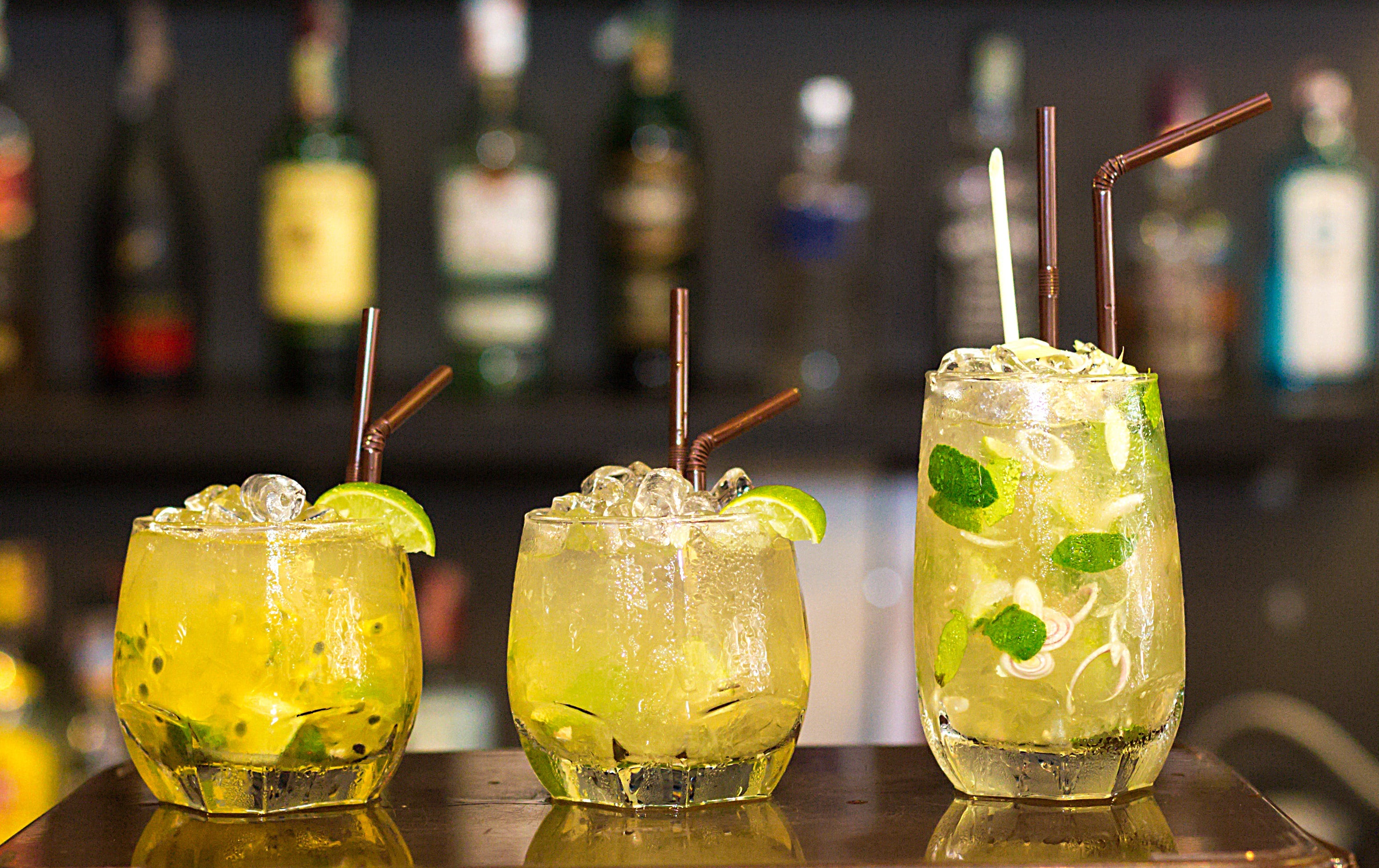
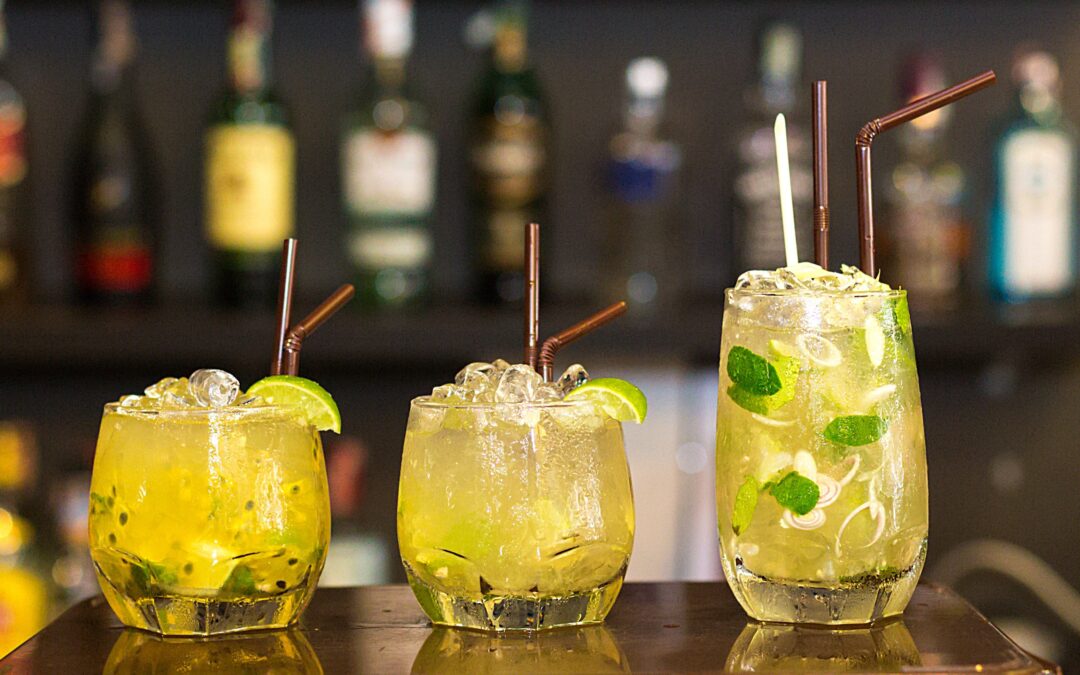
For us at Churrasco Phuket Steakhouse, the Caipirinha fits naturally into the rhythm of what we do. There is something satisfying about serving a drink that shares the same cultural DNA as our menu. Our Churrasco Signature Caipirinha stays fiercely loyal to the classic formula, allowing good Cachaça and properly prepared lime to carry the conversation. Our Passion Fruit Caipirinha leans towards the tropical, adding a layer of fragrance while preserving the citrus backbone that keeps the drink precise. And then there is our unique signature Thai-Pirinha (above right), where lemongrass and lime leaves introduce a Southeast Asian accent that complements Cachaça’s grassy profile in a considered way.
In an age where complexity is often mistaken for sophistication, there is something quietly intelligent about a cocktail that understands its limits and thrives within them. Four ingredients, properly handled, moving together with the ease of a well rehearsed samba. And that is all a real Caipirinha needs to do.
Image Credit: https://churrascophuket.com (Actual Menu Picture)
_ _ _
© CHURRASCO PHUKET STEAKHOUSE / ALL RIGHTS RESERVED
Reprinting, reposting & sharing allowed, in exchange for a backlink and credits
Churrasco Phuket Steakhouse serves affordable Wagyu and Black Angus steaks and burgers. We are open daily from 12noon to 11pm at Jungceylon Shopping Center in Patong / Phuket.
We are family-friendly and offer free parking and Wi-Fi for guests. See our menus, reserve your table, find our location, and check all guest reviews here:
https://ChurrascoPhuket.com/
#Churrascophuket #jungceylon #phuketsteakhouse #affordablewagyu #wagyu
by lspeed | Mar 1, 2026 | KNOWLEDGE: MEAT ESSENTIALS
We have been running high volume steakhouses long enough to recognise patterns, not only in Asia where we operate, but internationally. Food trends always arrive with conviction, confidence and usually a lot of press and influencer fluff. They peak somewhere between curiosity and virtue, and then quietly test whether guests actually want to order them twice.
Molecular foams had their moment. Activated charcoal had its fifteen minutes. Sous Vide found a secure place in modern culinary processes, and gold leaf still turns up occasionally, clinging stubbornly to desserts that never asked for jewellery.
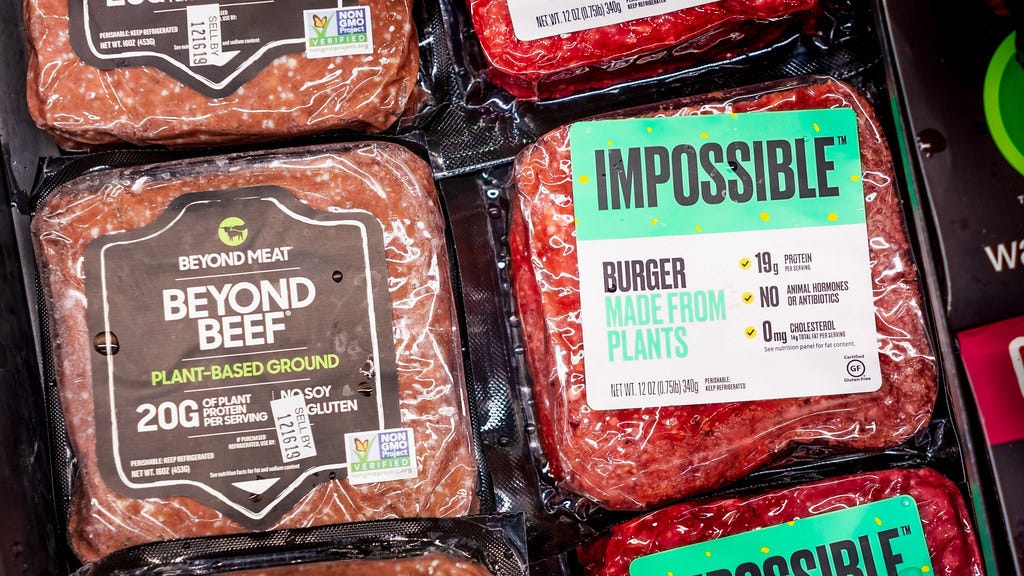
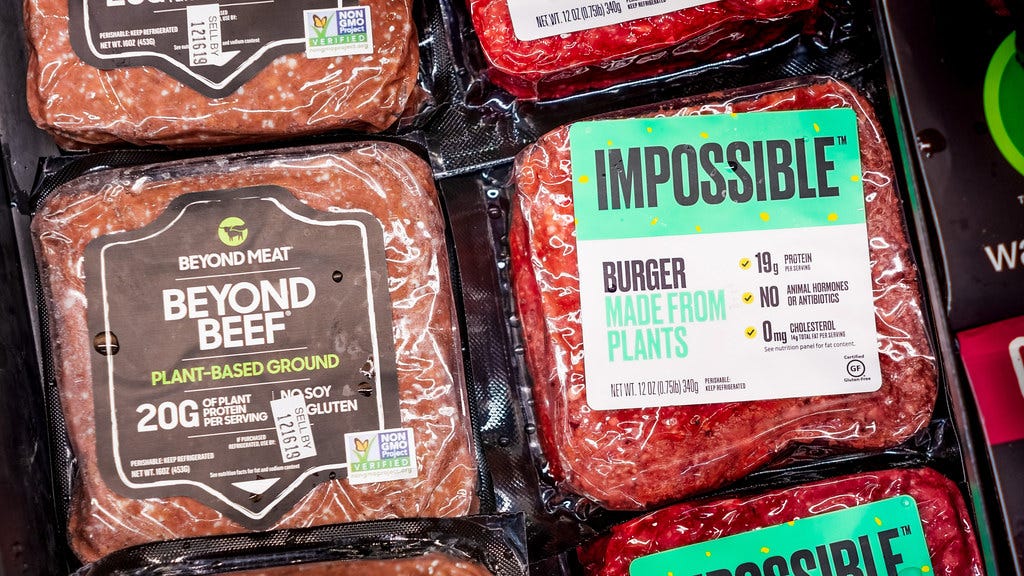
So when plant based meat arrived, we did what we were supposed to do. We listened, we tasted, we ran some numbers, and then we put it on our menu. The motivation was not ideological, but practical. We were also a bit tired of that those moments at the table when seven enthusiastic carnivores pause politely while the eighth guest asked if there is anything suitable for them.
Plant based meat promised to smooth that moment out, offering familiarity without compromise, at least in theory. We started where the category performs best, with burgers. Later we tested the products with a few of our Asian dishes, because any product that can’t survive a hot wok, a grill and a sauce with a strong personality is unlikely to last long in this part of the world.
Then we waited and observed. A year later, we took it all off the menu again.
The numbers told the story with brutal clarity. On average, plant based meat generated roughly one order a month. Occasionally two, often none. This was not quiet sabotage, and we did not hide it in small print or price it punitively. The kitchen handled it with care, the service team understood the product, and it sat visibly on the menu for all to see.
Guests simply did not order it. What surprised us was not the reaction of dedicated meat lovers, which was always predictable. What surprised us was Asia, because Asia does not need fake meat, and this is where Western narratives misread the room.
Asian Chefs have been cooking deeply satisfying plant based food for centuries, without pretending it is something else. Tofu, tempeh, mushrooms, jackfruit, wheat gluten and fermented beans are not substitutes or apologies. They are complete cuisines in their own right, built on technique, texture and umami rather than imitation.
If you grow up with mapo tofu, you do not crave pea protein pretending to be pork. And if you are familiar with Buddhist vegetarian cooking, mock goose included, you already understand structure and savouriness without needing the illusion of beef. When a food culture is grounded in balance, fermentation and layering of flavours, novelty alone struggles to hold attention for very long.
Impossible Pork basil rice, plant based Rendang, and fake Satay made some sense conceptually. But in execution, they fall short. Stir frying is unforgiving, and high heat exposes texture immediately. Oil absorption becomes unpredictable, and sauces highlight weaknesses rather than hide them. What behaves well between a bun does not necessarily behave well in a wok.
Price compounded the issue. Asia’s foodies are intensely price literate, and know what pork and chicken and tofu and vegetables cost. Asking them to pay more for something more processed, less familiar and not clearly tastier was always going to be a challenge. Once the novelty faded, logic returned to the table. Health perceptions did not rescue the category either. Ultra processed is not a compelling selling point in a region where wet markets, fresh produce and daily shopping are still part of everyday life.
From our perspective as a restaurant operator, the negatives started piling up. Storage requirements were awkward, shelf life was short, and supply was inconsistent. Staff had to remember special handling protocols for an item ordered once a month. Menu space is finite and every dish has to justify its place. This one did not, so we removed it. End of story.
Does this mean plant based meat is finished. Not at all, we say, just that the hype phase is over, and whatever comes next will need to earn its place honestly. We see three future scenarios look plausible:
Blended Meats
This is the most realistic path forward. Burgers that are mostly beef with plant proteins folded in for yield and sustainability. Sausages that use mushrooms for juiciness and structure. Less meat rather than no meat. Taste remains familiar, price pressure eases, and environmental impact improves without asking guests to make a philosophical leap. Asia tends to favour pragmatic compromise over absolutism, and this approach fits that mindset well.
Food That Stops Pretending
The strongest vegetarian dishes in Asia succeed because they are honest. Tofu tastes like tofu, and mushrooms taste like mushrooms. Mycelium is used for texture, not disguise. When plant based products aim to be delicious on their own terms rather than imitating steak, chefs can actually work with them creatively. This shift is already happening quietly, and it feels far more durable.
Functional Niches
Airlines, hospitals, institutional catering and disaster relief environments value shelf stability, protein density and standardisation more than romance. Plant based meat fits these use cases well. It does not need to be loved, just to work.
As successful steakhouse operators, we never felt threatened by plant based meat. If anything, the experiment reaffirmed something reassuring. People who want steak will order steak, and people who want vegetables are perfectly happy eating vegetables. Especially in Asia, where plant based food never needed a lab coat to be taken seriously.
Image Credit: https://www.bath.ac.uk/ (University of Bath)
_ _ _
© CHURRASCO PHUKET STEAKHOUSE / ALL RIGHTS RESERVED
Reprinting, reposting & sharing allowed, in exchange for a backlink and credits
Churrasco Phuket Steakhouse serves affordable Wagyu and Black Angus steaks and burgers. We are open daily from 12noon to 11pm at Jungceylon Shopping Center in Patong / Phuket.
We are family-friendly and offer free parking and Wi-Fi for guests. See our menus, reserve your table, find our location, and check all guest reviews here:
https://ChurrascoPhuket.com/
#Churrascophuket #jungceylon #phuketsteakhouse #affordablewagyu #wagyu
by lspeed | Feb 25, 2026 | KNOWLEDGE: MEAT ESSENTIALS
If there is one contest that runs deeper than rugby, cricket, or who invented the flat white, it might just be lamb. Put a Kiwi and an Ozzie in the same room and casually mention sheep, and you will want to reach for the popcorn and enjoy the show.
Both countries are global heavyweights in lamb production. Both export to the world, and are equally fiercely proud of their farming traditions. And both will quietly suggest that the other one is doing it almost right. So what is the actual score when it comes to what lands on your plate?
Round One: New Zealand, Grass Fed and Gloriously Green
New Zealand lamb has built its reputation on purity. Think open hills, dramatic coastlines, and sheep grazing freely on rich, rain nourished pastures. The country’s mild climate and generous rainfall mean lambs spend their lives on grass, not in feedlots. The result is meat that is typically leaner, fine grained, and delicately flavoured. There is a clean, almost herbal note to properly raised New Zealand lamb. It tastes of pasture in the best possible way. Not wild or gamey, just fresh and honest.
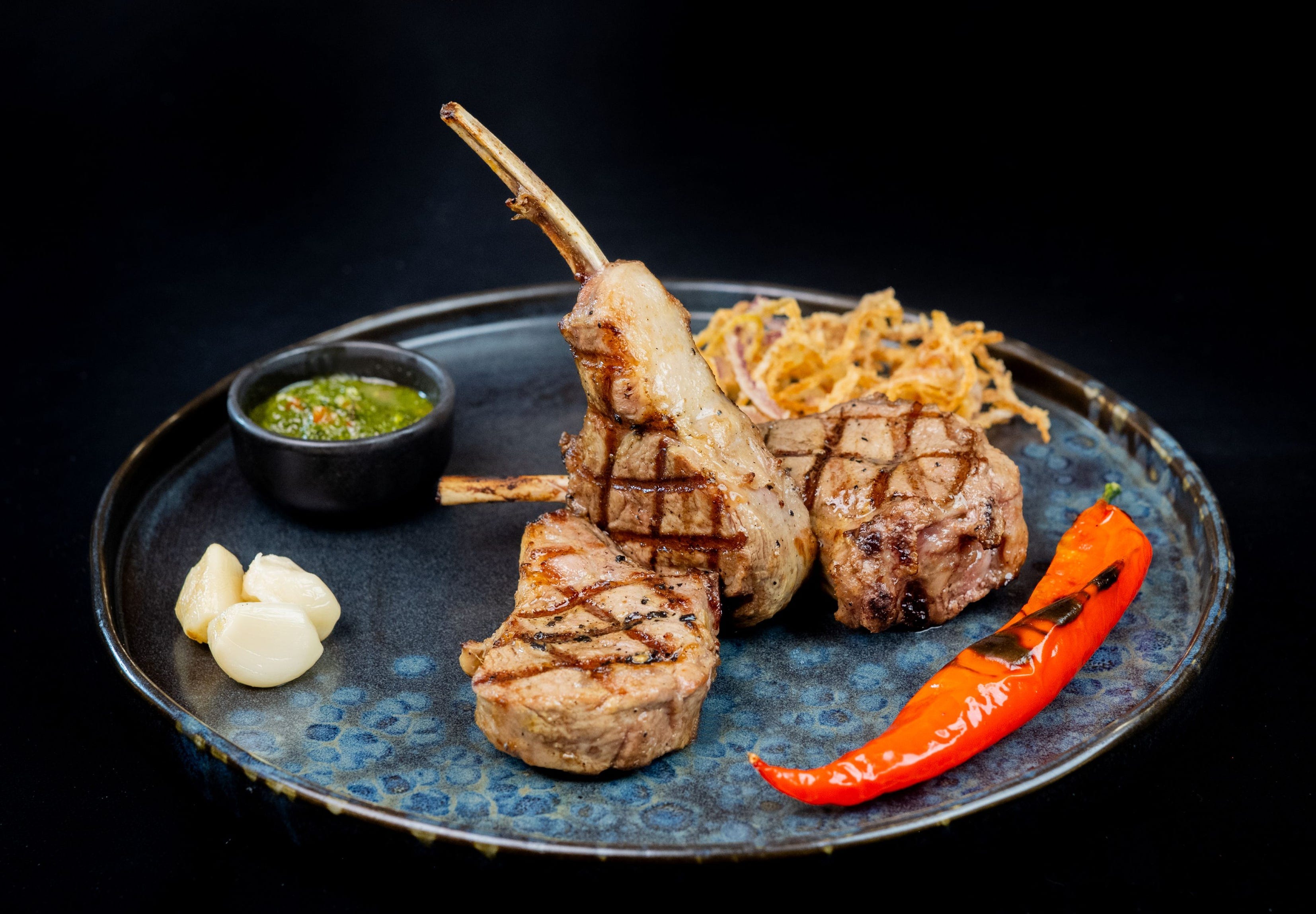
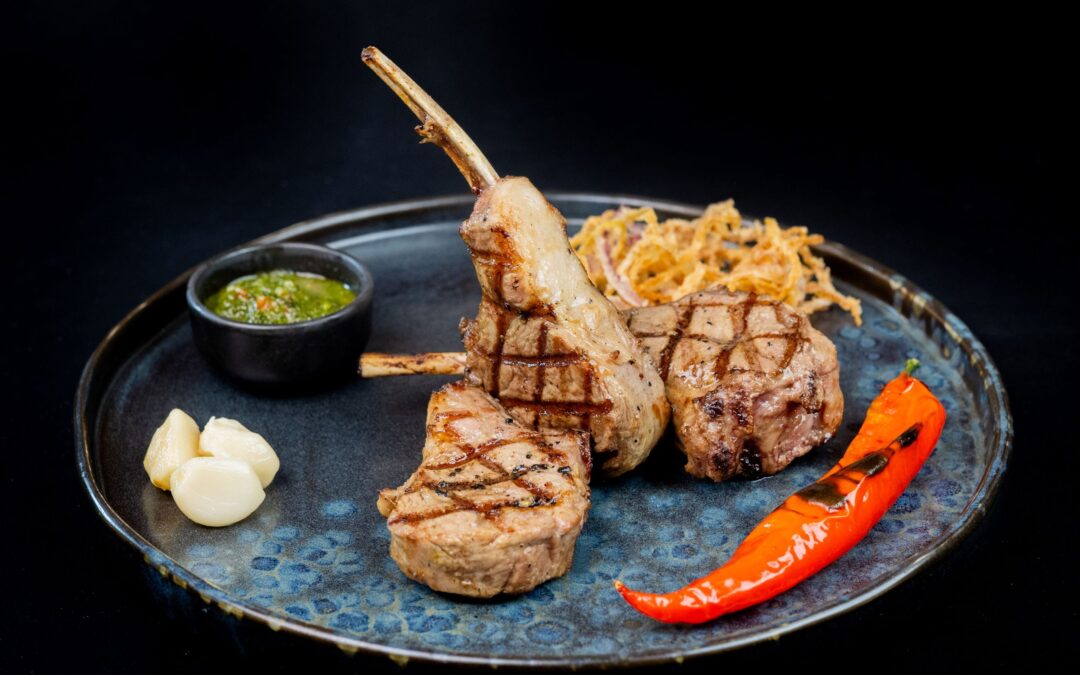
Because New Zealand lambs are generally processed at a younger age, the texture tends to be tender and refined. Smaller cuts, elegant racks, and neat chops lend themselves beautifully to quick cooking methods and haute cuisine plating. A hot grill, a well judged roast, or a sharp sear in a pan. You do not need to bully it with heavy sauces or aggressive spices. Let the lamb speak. It usually does so politely, but with quiet confidence.
New Zealand also leans heavily into strict farming standards and traceability. Animal welfare, sustainability, and environmental stewardship are not marketing buzzwords there. They are part of the national identity. For diners who care about how their protein was raised, that matters.
Round Two: Australia, Bigger, Bolder, and Not Shy About It
Australia approaches lamb the way it approaches most things – with scale. Vast landscapes and diverse climates, from dry inland regions to lush coastal pastures. Australian lamb production covers serious ground. While a large proportion of Australian lamb is grass fed, some producers finish their animals on grain. That finishing step changes things, as grain finishing increases intramuscular fat and deepens the flavour profile, just as it does with beef.
The meat often carries a richer, more robust taste and a slightly fattier mouthfeel. Australian lamb also tends to be larger. Bigger shoulders, larger legs, and cuts that feel designed for Sunday roasts, slow braises, and dishes that demand presence. If you are building a lamb curry that needs to hold its own against spice, or a slow cooked stew that simmers for hours, Australian lamb steps into the ring with confidence. It’s bold, it’s hearty, and it does not whisper.
So What Is the Score: The Taste Debate
The fun part of this rivalry is that it mirrors the broader New Zealand versus Australia dynamic. The Kiwis will say their lamb is cleaner, more refined, and raised in greener conditions. The Australians will counter that theirs has more depth, more character, more punch. It is a bit like comparing two great rugby teams. Style versus power, and precision versus impact. Both can win, depending on the day and the crowd.
From a chef’s perspective, the choice often comes down to intent. Do you want a lamb rack that shines with just salt, pepper, and careful grilling? New Zealand is hard to beat. Do you want a shoulder that collapses into sticky richness after hours in the oven? Australia may have the edge.
Neither is “better” in some universal sense. They are simply different expressions of climate, feed, farming philosophy, and culinary tradition. In essence, the world is lucky to have both. Between them, New Zealand and Australia have set the global benchmark for exported lamb. The rivalry keeps standards high. The competition drives improvement, and diners everywhere benefit.
As for the bragging rights across the Tasman Sea, that debate will continue long after the last chop has been served. Which is probably exactly how both countries like it.
Image Credit: https://churrascophuket.com (Actual Menu Picture)
_ _ _
© CHURRASCO PHUKET STEAKHOUSE / ALL RIGHTS RESERVED
Reprinting, reposting & sharing allowed, in exchange for a backlink and credits
Churrasco Phuket Steakhouse serves affordable Wagyu and Black Angus steaks and burgers. We are open daily from 12noon to 11pm at Jungceylon Shopping Center in Patong / Phuket.
We are family-friendly and offer free parking and Wi-Fi for guests. See our menus, reserve your table, find our location, and check all guest reviews here:
https://ChurrascoPhuket.com/
#Churrascophuket #jungceylon #phuketsteakhouse #affordablewagyu #wagyu