
Some cocktails impress with theatre. They arrive under glass domes filled with smoke, garnished with herbs foraged by a philosopher, and accompanied by a backstory that involves at least one prohibition era gangster. The Caipirinha does not bother with any of that. It stands in the glass, bright and unapologetic, quietly confident in the knowledge that four ingredients, handled properly, can outshine a whole laboratory of mixology tricks.
Brazil’s national cocktail was never designed to be glamorous. The word “Caipirinha” roughly translates to “little country girl” or “little hillbilly,” depending on how generous you feel. Its roots lie in the rural interior of São Paulo in the early twentieth century, where a mixture of lime, sugar and Cachaça reportedly began life as a homespun medicine against the Spanish flu epidemic. Lime offered Vitamin C, sugar provided energy, and Cachaça – so it was hoped – improved the patient’s interest in recovery and the best samba times still to come. What started as practical medicine gradually shed its therapeutic pretence and evolved into something far more important: a social ritual.
At the heart of the Caipirinha is Cachaça, a spirit that predates the cocktail by centuries. First distilled in the sixteenth century on Brazil’s sugarcane plantations, Cachaça is made from fresh sugarcane juice rather than molasses. This distinguishes it from most rums and gives it a distinctly grassy, slightly earthy character. Brazil produces vast quantities of it every year, from industrial bottlings destined for beach kiosks to small batch, barrel-aged expressions that can hold their own in serious tasting circles. It is a spirit with both working class roots and aristocratic ambitions, which feels entirely on brand for a country that moves comfortably between barefoot beach culture and architectural modernism.
In a Caipirinha, however, Cachaça is not trying to prove its pedigree. Its job is to play lead partner to lime, and like any good Latin dance, the success lies in both balance and bravado. Fresh lime wedges are muddled with sugar, just enough pressure to release fragrant oils from the peel and bright juice from the flesh without extracting bitterness. The Cachaça follows, ice settles in, and the mixture is stirred until sweet, sour and spirit align in a way that feels effortless and instinctive. When done well, the drink is neither cloying nor aggressively sharp, but taut and refreshing, with a warmth that arrives a few seconds after the citrus spark.
Part of the Caipirinha’s charm is that it belongs everywhere. In Brazil it appears at beachside kiosks in Rio de Janeiro, at Feijoada lunches in São Paulo (Brazil’s national dish, a rich black bean stew), at impromptu neighbourhood gatherings, and at refined cocktail bars that present it with studied nonchalance. It is democratic without being dull, festive without being frantic, and it pairs particularly well with Latin grilled meat cuts, especially Picanha or Maminha. This explains why it feels so at home in a steakhouse setting like ours at Churrasco Phuket Steakhouse. The acidity cuts cleanly through fat, the sugar softens char, and the Cachaça threads everything together with a subtle sugarcane hum.
As global cocktail culture grew, the Caipirinha travelled. It appeared on menus from London to Singapore to Nairobi, often positioned as an exotic alternative to the Margarita or Mojito. Inevitably, it invited interpretation and variations multiplied. Vodka stepped in to create the Caipiroska, and rum offered the Caipirissima. Bartenders began folding in passion fruit, mango and other tropical accents. Some adaptations feel thoughtful, others contrived. But the original remains the reference point, a reminder that restraint can be more sexy than excess.
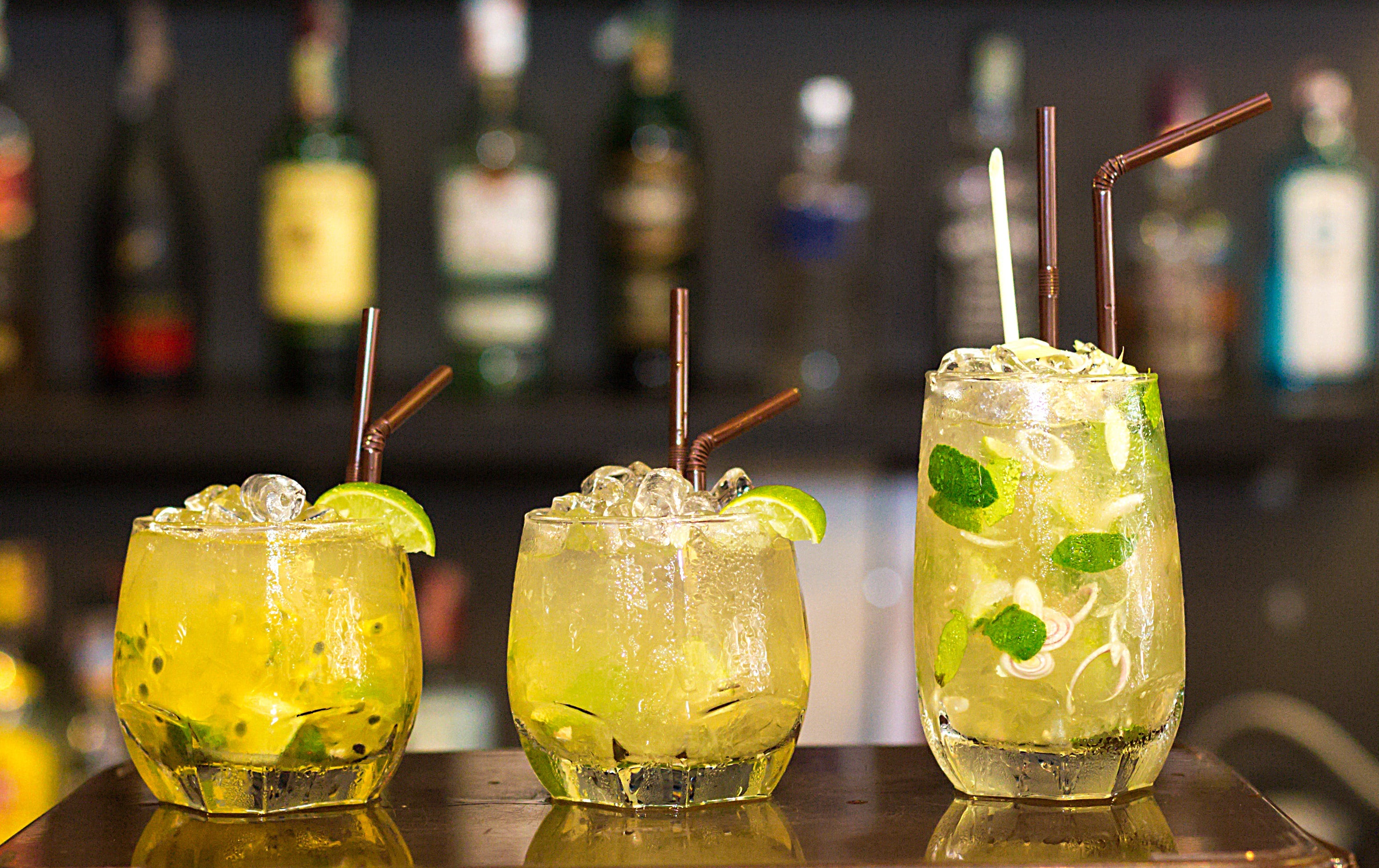
For us at Churrasco Phuket Steakhouse, the Caipirinha fits naturally into the rhythm of what we do. There is something satisfying about serving a drink that shares the same cultural DNA as our menu. Our Churrasco Signature Caipirinha stays fiercely loyal to the classic formula, allowing good Cachaça and properly prepared lime to carry the conversation. Our Passion Fruit Caipirinha leans towards the tropical, adding a layer of fragrance while preserving the citrus backbone that keeps the drink precise. And then there is our unique signature Thai-Pirinha (above right), where lemongrass and lime leaves introduce a Southeast Asian accent that complements Cachaça’s grassy profile in a considered way.
In an age where complexity is often mistaken for sophistication, there is something quietly intelligent about a cocktail that understands its limits and thrives within them. Four ingredients, properly handled, moving together with the ease of a well rehearsed samba. And that is all a real Caipirinha needs to do.
Image Credit: https://churrascophuket.com (Actual Menu Picture)
_ _ _
© CHURRASCO PHUKET STEAKHOUSE / ALL RIGHTS RESERVED
Reprinting, reposting & sharing allowed, in exchange for a backlink and credits
Churrasco Phuket Steakhouse serves affordable Wagyu and Black Angus steaks and burgers. We are open daily from 12noon to 11pm at Jungceylon Shopping Center in Patong / Phuket.
We are family-friendly and offer free parking and Wi-Fi for guests. See our menus, reserve your table, find our location, and check all guest reviews here:
https://ChurrascoPhuket.com/
#Churrascophuket #jungceylon #phuketsteakhouse #affordablewagyu #wagyu