
BACALAO: HOW SALTED COD CONQUERED THE WORLD
To us as restaurant owners, nothing is more important than freshness. We buy vegetables daily, make our sauces from scratch, and insist that all our imported meats arrive deep-chilled rather than frozen. We have occasionally sent entire beef deliveries back because we could tell they had been frozen before they arrived, even if it meant that some menu items would be unavailable for the day. So we find it kind of hilarious that one of the enduring culinary traditions of the Latin world is built around a fish that conquered half the world precisely because nobody needed it to be fresh.
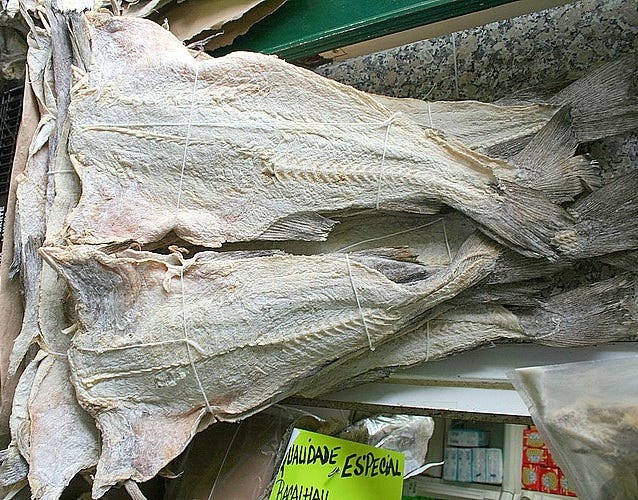
Salt cod began as dire necessity rather than brilliant gastronomy. The North Atlantic was full of cod, but many people who wanted to eat it lived thousands of kilometres away. Norse cultures dried cod into stockfish that would last for months, and traders relied on salt for preservation. Religion then provided a massive marketing boost, because Catholics observe so many meatless days, particularly Fridays and Lent. A fish able to survive a long journey and sit patiently in a storeroom was both useful and valuable.
Nobody seems quite sure where the name of this peculiar dried fish comes from. One theory is that the word is related to the Dutch kabeljauw (cod), with the sounds of the word adapted as it travelled south to the Iberian Peninsula. Another suggests it may come from the Latin baculum, meaning stick, because dried cod is as stiff as one. Culinary history is full of such linguistic migrations and contortions, but in the end it’s all about taste and acceptance.
Venice turned it into baccalà mantecato, a Venetian menu mainstay, by working the soaked fish with olive oil until pale and almost mousse-like, then serving it on polenta or crostini. Further inland in Vicenza, bacalà alla vicentina is cooked slowly with onions, anchovies, olive oil and milk until soft and rich. Confusingly, both cities use the word baccalà for dried stockfish, while other Italians use it for salt cod. We don’t get involved, because one of our owners is Italian, and know better than to referee them about food.
Portugal took the relationship further than anyone. Its fishermen sailed as far as Newfoundland in search of cod, and bacalhau became central to the national kitchen. Hence the famous claim of 365 recipes, one for every day of the year. Spain developed its own formidable tradition, including the Basque bacalao al pil-pil, where cod, garlic and olive oil are gently worked together until the fish’s natural gelatin emulsifies with the oil to create a thick, silky sauce. With so few ingredients, there is nowhere for the cook to hide, which is why chefs have so much respect for it.
The fish eventually crossed the Atlantic, but for much less romantic reasons. Salt cod became an important food in the Caribbean plantation economy, including as provisions for enslaved workers. Over time, it was absorbed into local cooking, and Jamaica’s ackee and saltfish became the national dish. Other expressions, like bacalao guisado, combine shredded cod with tomatoes, peppers, onions, olives and capers. A preservation method developed around the cold North Atlantic had found an entirely new tropical life in the Caribbean.
South America embraced it too, most obviously in Brazil, where Portuguese colonisation brought the bacalhau tradition across the Atlantic. It remains closely associated with Christmas, Easter and family celebrations. Brazilians bake it with potatoes, onions, peppers, olives and plenty of olive oil, and turn it into casseroles and bolinhos de bacalhau, crisp little salt-cod fritters that quickly disappear at parties. Elsewhere on the continent, particularly in countries with strong Spanish and Portuguese influence, salt cod appears in stews, empanadas and Easter dishes.
As a South American steakhouse, we have occasionally debated adding it to the menu. So far the answer has been no, because anything that needs days of soaking before cooking would lead to a mass kitchen staff exodus. And we are a steakhouse, after all. But we have enormous respect for an ingredient that travelled from the North Atlantic to Italy, Iberia, the Caribbean and South America, changing character wherever it landed.
Sometimes, freshness isn’t everything.
Image Credit: https://en.wikipedia.org/wiki/Dried_and_salted_cod
_ _ _
© CHURRASCO PHUKET STEAKHOUSE / ALL RIGHTS RESERVED
Reprinting, reposting & sharing allowed, in exchange for a backlink and credits
Churrasco Phuket Steakhouse serves affordable Wagyu and Black Angus steaks and burgers. We are open daily from 12noon to 11pm at Jungceylon Shopping Center in Patong / Phuket.
We are family-friendly and offer free parking and Wi-Fi for guests. See our menus, reserve your table, find our location, and check all guest reviews here:
https://ChurrascoPhuket.com/
#Churrascophuket #jungceylon #phuketsteakhouse #affordablewagyu #wagyu