
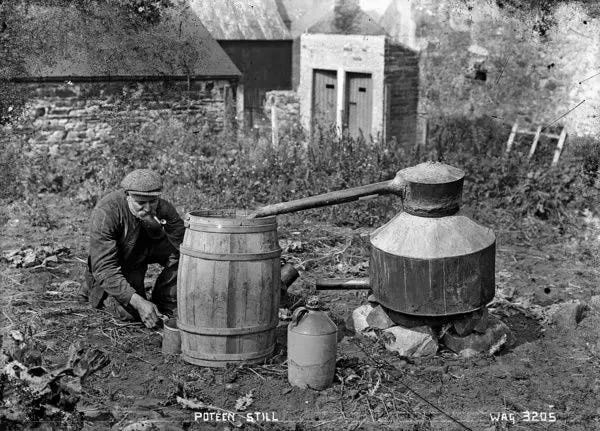
Many Irish whiskey lovers (note the correct spelling) have never heard that for more than three centuries, Ireland had a national drink that officially didn’t exist. Made on remote farms, hidden in wonky sheds, and distilled behind lonely hills, it was only occasionally discovered by thirsty policemen who weren’t always surprised to find it.
Pronounced roughly put-cheen, the name comes from the Irish pota, meaning pot. Specifically the small pot stills in which it was traditionally distilled. Its ancestry stretches back centuries, to the uisce beatha, or the “water of life” produced in medieval Ireland. Long before whiskey became respectable enough for mahogany bars and airport duty-free shops, rural Irishmen were turning grain into something considerably more entertaining.
The trouble for them began, inevitably, with taxation. Licensing of distillation appeared in Ireland in the 16th century, and by the 1660s the authorities saw alcohol as an excellent source of revenue. Large licensed distillers paid their dues, but farmers with small stills opted for a more economical course of action. Thus emerged the distinction of taxed commercial whiskey on one side, and illicit unaged Poitín on the other.
For the next 300-odd years, making Poitín was part cottage industry, and part cat-and-mouse game. Stills migrated to remote valleys, islands and hillsides. Turf fires were lit in windy weather to disperse the smoke before attracting unwanted official attention. Stills were positioned near property boundaries, allowing ownership to become wonderfully uncertain when the revenue department showed up.
Over time, the drink acquired a formidably rogue reputation. During the Second World War, American servicemen stationed in Northern Ireland were warned about the local potheen in their pocket guides. The stated verdict was a concise “it is dynamite”, earned by its strength. Modern and now legal Poitín starts at 40% alcohol, but rogue or brave versions did and still can climb dramatically higher.
Traditionally made from barley or oats or whatever the countryside supplied. Alternatives were potatoes, sugar beet and other fermentable ingredients. Yet, Poitín was never merely Irish moonshine. It became part of folklore and identity, particularly in western counties such as Galway, Mayo and Donegal. It appears in literature and songs, including The Hills of Connemara and The Rare Old Mountain Dew. Frank McCourt wrote about it, and playwright Martin McDonagh put it into his characters’ hands.
The unlikely transformation from outlaw hooch to brand ambassador came in 1997, with the emergence of legal commercial Poitín in Ireland. Moving up in the polite world, Irish Poitín received European geographical protection in 2008, putting the former contraband booze into the same broad protected-origin world as other distinctly regional European drinks.
Its production is now formally defined and regulated, with names such as Bán, Micil, Mad March Hare and Frank Carr’s pushing Poitín beyond Ireland. Bartenders discovered that its grainy, earthy character works remarkably well in the wilder side of the cocktail spectrum. It even does amazingly well as the core ingredient in Irish Coffee.
The international drinks trade has started treating it less as an Irish curiosity and more as a serious spirits category. And that is its future, I think. Consumers want small-batch spirits with provenance, authenticity and a cool story.
Poitín possesses all three in abundance.
Image Credit: https://spiritstraining.com/cdn/shop/articles/Poitin_600x.png
_ _ _
© CHURRASCO PHUKET STEAKHOUSE / ALL RIGHTS RESERVED
Reprinting, reposting & sharing allowed, in exchange for a backlink and credits
Churrasco Phuket Steakhouse serves affordable Wagyu and Black Angus steaks and burgers. We are open daily from 12noon to 11pm at Jungceylon Shopping Center in Patong / Phuket.
We are family-friendly and offer free parking and Wi-Fi for guests. See our menus, reserve your table, find our location, and check all guest reviews here:
https://ChurrascoPhuket.com/
#Churrascophuket #jungceylon #phuketsteakhouse #affordablewagyu #wagyu