
The burger began life with all the glamour of wet rope and dockyard grit. Its ancestor, the Hamburg steak, arrived in late 19th century America, courtesy of German immigrants who had little culture and patience for culinary theatrics. This was minced beef, seasoned, cooked, and dispatched with efficiency – no garnish, no narrative, and no ambition beyond solving hunger pangs. When placed between two slices of bread with Teutonic efficiency, the modern burger clicked into place. Portable, edible, and structurally sound, it was less a dish than a piece of food engineering.
What followed was not evolution but global opportunism. The burger was built on a flexible blueprint and proved remarkably easy to export. America standardised it, scaled it, and sent it out into the world as both product and idea. Fast, cheap, consistent, and only very faintly indulgent, it was the edible equivalent of a well run assembly line. When it arrived in foreign markets, it did what all successful emigrants do – adapt quickly and without sentiment.
Local Flavours, Same Core Idea
Japan gave it teriyaki, a lacquer of sweet soy that turned it into something exotic. India removed the beef altogether and replaced it with Aloo Tikki, a spiced potato patty that retained the structure while rewiring the substance. Mexico, predictably, added heat and generosity, layering jalapeños, avocado, and enough personality to make the original look underdressed. Variations appeared everywhere, each one bending the rules without breaking the format. The burger’s genius lies in its elasticity. Change the filling, adjust the seasoning, swap the bun, and it is still a burger.
A Move Upmarket
For most of its life, it remained aggressively democratic. It belonged to the street, the roadside stand, the fast food counter humming with fluorescent excess. It was eaten standing up, in cars, at desks, occasionally with moments of regret. It required no explanation and you knew exactly what you were getting. Then, in the early 2000s, the burger wandered into better neighbourhoods and stubbornly refused to leave. Chefs and restaurant owners began to reconsider it, because here was a format that everyone understood, a blank canvas disguised as comfort food.
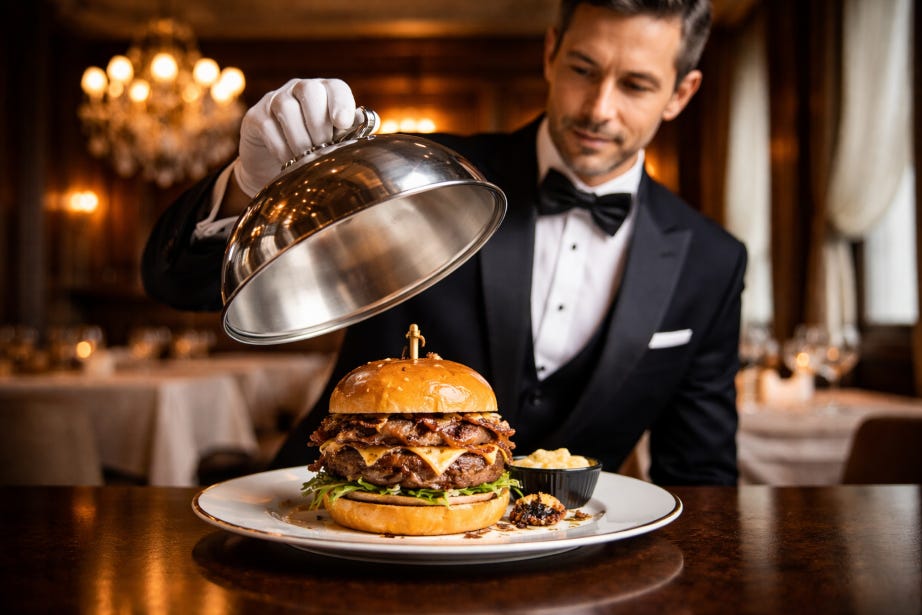
So, why not elevate it by taking something deliberately ordinary and treat it with the seriousness reserved for white tablecloth settings. The results have landed somewhere between impressive and ridiculous. Wagyu beef, with its intricate marbling and higher cost, successfully replaced standard mince in the right settings. Black truffles and foie gras made their inevitable entrance, because restraint had left the building. Brioche buns appeared, richer and just indulgent enough to suggest that the burger had started growing ambitions. There are weird gold leaf versions too, which are both edible and entirely unnecessary, a rare culinary achievement in itself.
The Big Boys Join The Climb
The familiar chains were watching all this with a mixture of curiosity and mild panic and attempted their own upgrades. This did not always go down well. McDonald’s flirted with premium lines such as their “Signature” and “Gourmet” ranges, swapping sesame buns for brioche and adding ingredients that sounded like they had attended but never finished graduate school. The problem was not the idea but the setting, because a softly lit description loses its charm under fluorescent lighting and next to a self service kiosk.
Burger King tried similar manoeuvres, leaning on Angus beef and thicker patties, occasionally landing a decent result but rarely shaking off the sense that this was a familiar product wearing a borrowed jacket. Wendy’s has arguably done better, leaning into fresh beef positioning and incremental upgrades rather than full theatrical reinvention. Meanwhile, various limited edition “luxury” launches across the industry have come and gone with the quiet dignity of a short lived experiment. It proves the hard gastronomical truth that you can adjust ingredients, but a truffle mayo can only do so much for you when eaten in a moving car.
New Players, Same Issues
The newer generation introduced themselves with the confidence and pricing of tech start ups. Shake Shack polished the model with tidy branding, cleaner sourcing narratives, and burgers that had manners. Five Guys doubled down on customisation and abundance, offering peanuts as a side dish and the reassuring sense that excess was allowed. Smashburger went into full commando mode with the technique, flattening patties onto searing grills with evangelical zeal. All three flirted with being “posh”, or at least the idea of it, but the outcome remains curiously similar. The setting is still casual, the service still functional, and the experience still fundamentally transactional. Prices crept upward and language became more polished, but the leap to genuine luxury never materialised. Better ingredients and sharper branding alone cannot disguise that you are still queuing, still carrying your own tray, and still deciding if you really want to sit next to that overflowing trash can.
The Steakhouse Angle
And yet, the upmarket appeal holds. The luxury burger works because it plays both sides, offering faint nostalgia and indulgence in the same bite. It allows chefs like ours to showcase sourcing, technique, and imagination, while diners get to pretend that what they are eating is still casual. It is comfort food in a tailored jacket, and at Churrasco Phuket Steakhouse, this shift came not as a reinvention, but a logical extension of what already worked for us.
A kitchen like ours that understands beef at a very serious level will sooner or later turn its attention to the better class burger. The result is the range of our every popular Wagyu gourmet burgers, built around quality ingredients and clear intent. Truffle and chimichurri combinations sit alongside classic Wagyu cheeseburgers, several creative but understandable smashburger options, and a Creole style lamb burger.
All are certified halal and designed with the same underlying principle – start with good product, treat it respectfully, and avoid unnecessary theatrics. No gold leafs for us, thank you. Our guests have embraced the idea. Our steakhouse burgers have always been about satisfaction, and adding better ingredients improved the experience rather than complicate it. Our affordable Wagyu burgers remain approachable, recognisable, and reassuringly unfussy, even when dressed up.
From dockside practicality to global luxury prop, the burger absorbed cultures, industrialisation, and somehow found its way onto menus where the lighting is dim and the prices are not. Through all of this, it has retained its essential logic that brilliant ideas do not need much improvement, just creativity, better ingredients – and the occasional sense of humour.
Image Credit: https://www.churrascophuket.com (AI Generated)
_ _ _
© CHURRASCO PHUKET STEAKHOUSE / ALL RIGHTS RESERVED
Reprinting, reposting & sharing allowed, in exchange for a backlink and credits
Churrasco Phuket Steakhouse serves affordable Wagyu and Black Angus steaks and burgers. We are open daily from 12noon to 11pm at Jungceylon Shopping Center in Patong / Phuket.
We are family-friendly and offer free parking and Wi-Fi for guests. See our menus, reserve your table, find our location, and check all guest reviews here:
https://ChurrascoPhuket.com/
#Churrascophuket #jungceylon #phuketsteakhouse #affordablewagyu #wagyu