
I come from a family of hunters, and my father held two firm beliefs about it. The first was that tramping through the forest with his salvaged WWII Mauser 98k sniper rifle would make a man out of me. The second was that if you killed an animal, you ate every part of it, no excuses, no exceptions. It made rack of venison dinners at our house an ever elusive treat, while venison lung hash became the house speciality. I still get the cold shivers when I think back to those meals, with my dad making sure that my plate came back clean. Or else.
So I have sympathy for anyone who – like me – is confronted with haggis for the first time. The Scots took my father’s credo and did something he thankfully never managed – turning animal spare parts into a national icon. In my family, lungs were a test of character, whereas in Scotland they are honoured with bagpipes, a poem, and a night of the year all to themselves.
Scotland has given the world many universally liked things, like whisky, golf, penicillin, the Loch Ness monster, and Sean Connery. But when it comes to haggis, the culinary world gets quickly divided between horror and elation. The famous mixture of sheep’s heart, liver and lungs, plus oatmeal, onion, suet and spices, is traditionally packed into the animal’s stomach and simmered. When written down like this, it sounds rather less like dinner, and more like something the chef forgot to quietly dispose of.
Aficionados assure me that Haggis deserves a break, and lovingly describe it as savoury, peppery and surprisingly delicate. The oatmeal absorbs the meat juices and giving it a loose, almost crumbly texture, with the flavour being close that of a particularly good rustic stuffing. So they say.
Its origins are even murkier than its ingredients. Scotland claims haggis as its own, but cooking chopped offal with grain inside an animal’s stomach is far older than the national identity now attached to it. Similar preparations existed elsewhere, and rather awkwardly, an English manuscript from the 15th century contains a recipe for something called hagese.
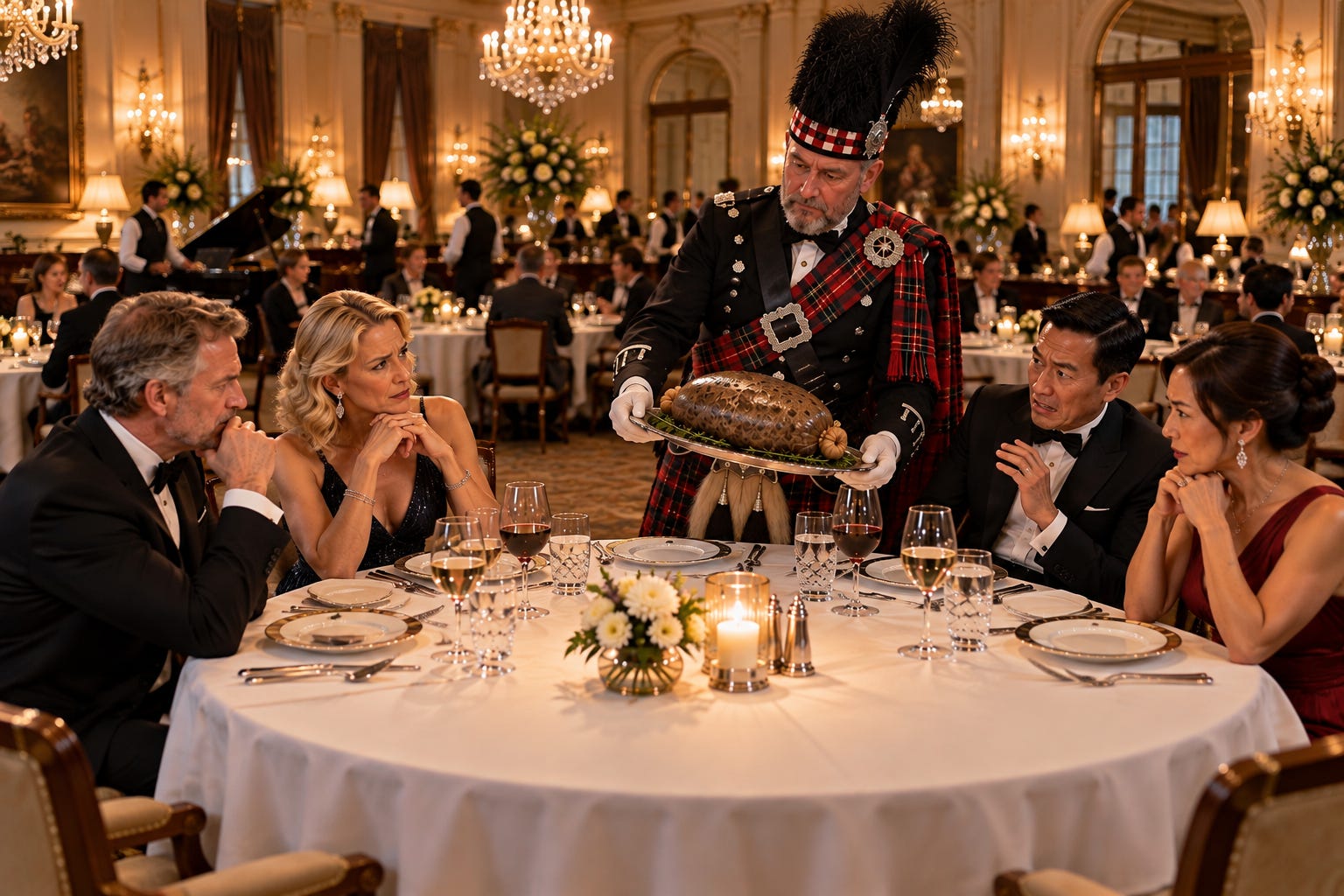
Food historians are welcome to argue over ownership, but Scotland won the marketing battle centuries ago, thanks to a a food writer by the name of Robert Burns. His 1786 Address to a Haggis elevated a humble pudding into the “Great chieftain o’ the puddin’-race”. Every January 25, Burns Night gives Scots a reason to recite poetry, before cutting into their Haggis, accompanied by the sound of bagpipes.
That is considerably more ceremony than any sheep’s innards could have expected in life. It is served with Neeps and Tatties (turnip and potatoes), and not surprisingly often comes with a whisky sauce. The combination makes sense, earthy, rich and buttery, precisely the sort of food for weather in which nobody is booking a table on the terrace.
The original idea was so sound that it explains its longevity. Throwing away edible organs at slaughter was wasteful, and since offal spoils quickly, it was chopped, seasoned and cooked. Even the stomach had its job to do as a natural cooking vessel – much like sausages and their intestine casings. This was nose-to-tail eating centuries before anyone thought of opening a themed restaurant with the phrase on the menu. My father would have approved – minus the poetry probably – because food was too serious a serious matter for light entertainment.
In America, sheep lungs are banned for human consumption since 1971. The traditional recipe therefore cannot be used in its original form, and American haggis tends to arrive anatomically edited. There also are vegetarian and “gourmet” versions around, and haggis now pop up in everything from burgers to canapés. Purists will raise an eyebrow, but since haggis was born from practicality, not culinary refinement, it seems unfair to be so exclusive on its behalf.
So yes, I’ll raise a dram to this great Scottish culinary pastime. Whether I’ll ever eat it again though is between me, the bagpipes, and my dad’s ghost.
Image Credit: https://www.churrascophuket.com (AI Generated)
_ _ _
© CHURRASCO PHUKET STEAKHOUSE / ALL RIGHTS RESERVED
Reprinting, reposting & sharing allowed, in exchange for a backlink and credits
Churrasco Phuket Steakhouse serves affordable Wagyu and Black Angus steaks and burgers. We are open daily from 12noon to 11pm at Jungceylon Shopping Center in Patong / Phuket.
We are family-friendly and offer free parking and Wi-Fi for guests. See our menus, reserve your table, find our location, and check all guest reviews here:
https://ChurrascoPhuket.com/
#Churrascophuket #jungceylon #phuketsteakhouse #affordablewagyu #wagyu