
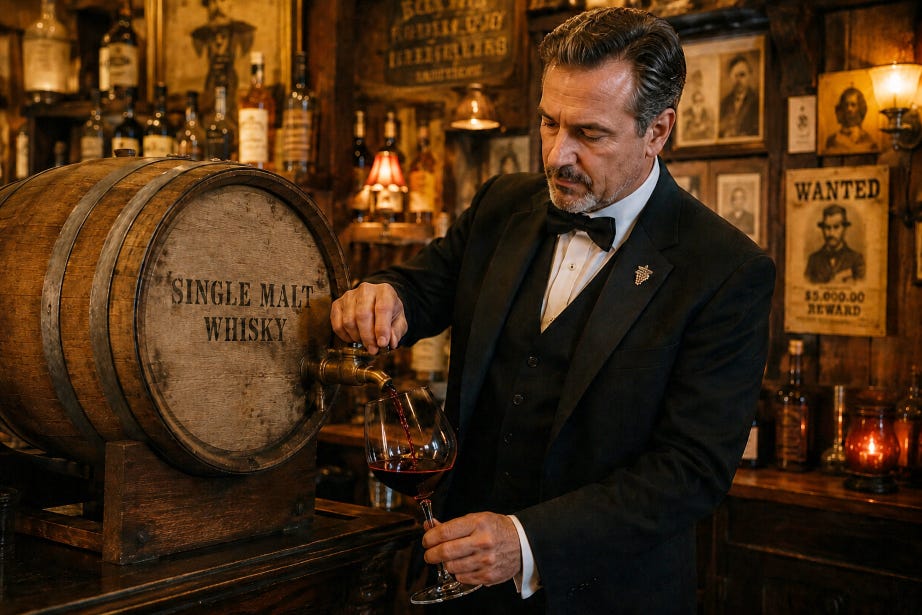
A few weeks ago, a friend met me for dinner at our steakhouse Churrasco Phuket, carrying a bottle of red wine that looked like it was ‘liberated’ from behind the counter of a dingy frontier saloon. The label read Three Finger Jack Rum Barrel Aged Red Blend, inspired by a legendary outlaw of the same name. He supposedly was some rogue character wandering through California’s foothills during the Gold Rush era in pursuit of riches and trouble in equal measure. The bottle looked dark, dramatic and somewhere reminiscent of a container for barbecue sauce.
As its label stated, this wine was partially aged in former rum barrels. To me as a traditionalist old school wine loving boomer, the whole concept of having wines aged in spirit barrels sounds like one of those ideas developed during a late night marketing meeting. One of those that involved too much bourbon or other suspect substances, and not enough restraint.
But curiosity tends to win at steak dinners, so we opened it. The wine itself turned out to be drinkable, built around Merlot, Syrah, and a touch of Petite Sirah, which delivered fruit, spice and a distinct but mild sweetness from the rum barrel ageing. There were other hints of something slightly molasses-like, ending in a rich, warm and unapologetically modern finish.
Not particularly subtle or elegant, but undeniably interesting and different.
And that seems to be the entire point of spirit barrel aged wine. Traditional wine regions spent generations, centuries even, refining strict rules around barrels and ageing and an endless list of other things. Bordeaux did not dedicate 200 years to perfecting Cabernet merely so somebody in California could finish Merlot inside an ex rum cask and sell it with outlaw branding. Scotch tasted like scotch, rum lived in the Caribbean, and bourbon dwelled in Kentucky. End of story.
That is, until someone somewhere decided to roll red wine into used spirit barrels and discovered that consumers rather liked the strange hybrid that emerged. The category exploded particularly in the United States during the 2010s, where experimentation in wine tends to be viewed not as heresy but as healthy entrepreneurship.
One of the better known examples is Robert Mondavi Private Selection Rum Barrel Aged Merlot, which combines plush California fruit with dark rum barrel influence. It became one of the first widely distributed wines of this category, proving that spirit barrel ageing was not just a passing fad. Then came Bota Box Rum Barrel Red Blend, which demonstrated that the category had moved into the mainstream. Once boxed wine joined the movement, it was safe to say the experiment had officially and successfully escaped the laboratory.
Bourbon barrel ageing soon entered the scene, and became even more popular than rum finishes. Apothic released Inferno, aged in whiskey barrels for 60 days. Josh Cellars launched Bourbon Barrel Cabernet. 19 Crimes embraced the style enthusiastically with its California red blends and celebrity collaborations. Cooper & Thief practically built an entire business model around spirit finished wines, experimenting with bourbon, rye whiskey, and brandy.
Some producers went even further. There are now tequila barrel aged Sauvignon Blancs, rye barrel Zinfandels, Scotch finished Pinot Noirs, and port wine cask Cabernet blends floating around the market. Some work surprisingly well, but many taste like a cocktail searching for the meaning of its existence.
Not surprisingly, traditional sommeliers are and will remain deeply skeptical. Their criticism is not unfair or snob-based, because spirit barrel ageing can overwhelm varietal character and mask terroir expression under layers of sweetness, smoke and oak. Clearly, a delicate Pinot Noir will not emerge from a bourbon barrel with much of its dignity intact.
But these boozy wines are not trying to compete with first growth Bordeaux or fine Burgundy. They occupy a completely different cultural lane, being designed for curiosity, accessibility and flavour impact rather than quiet refinement. Commercially, the strategy has been effective because it attracts drinkers who may not normally buy wine at all. Bourbon lovers understand bourbon barrels, and rum drinkers understand finely differentiated sweetness.
The flavour profile becomes immediately approachable without requiring encyclopedic wine knowledge or the skillful faking of it. It also reflects a wider shift in modern drinking culture. Younger consumers happily move between wine, cocktails, craft beer and whisky, without much concern for traditional boundaries. The old tribal loyalties between beverage categories are falling, and that is why these weird new wines will continue to grow.
As for that bottle of Three Finger Jack at our steak dinner, I am certainly not converted, remaining loyal to classic full-on reds with long pedigrees and deeply serious labels. But I will admit that this particular outlaw bottle disappeared rather quickly that night.
Image Credit: https://www.churrascophuket.com (AI Generated)
_ _ _
© CHURRASCO PHUKET STEAKHOUSE / ALL RIGHTS RESERVED
Reprinting, reposting & sharing allowed, in exchange for a backlink and credits
Churrasco Phuket Steakhouse serves affordable Wagyu and Black Angus steaks and burgers. We are open daily from 12noon to 11pm at Jungceylon Shopping Center in Patong / Phuket.
We are family-friendly and offer free parking and Wi-Fi for guests. See our menus, reserve your table, find our location, and check all guest reviews here:
https://ChurrascoPhuket.com/
#Churrascophuket #jungceylon #phuketsteakhouse #affordablewagyu #wagyu