
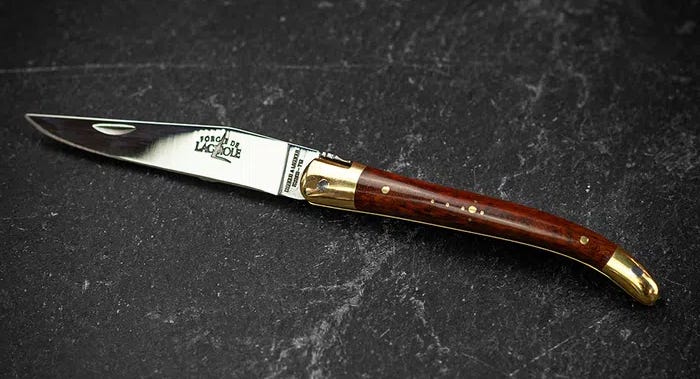
Before the Laguiole knife settled comfortably beside linen napkins and serious wine lists, it enjoyed a less respectable apprentice phase. In the late nineteenth and early twentieth century, certain spring loaded versions of the Laguiole quietly drifted into the darker back alleys of Paris. Slim, discreet, and quick in the hand, they were sometimes modified to open at lightning speed. Pressed into service as improvised switch blades, they were handy tools to “elevate the financial position” of their handler.
Not exactly brochure material, but every French icon seems to have a youthful chapter it prefers not to discuss over a polite lunch. Once that phase had passed, the Laguiole cleaned itself up remarkably well and went on to become one of France’s most recognisable everyday objects, and one of the world’s most iconic steak knives. Few tools have managed such a smooth transition from rural necessity to urban style, with only the occasional raised eyebrow or whispered comment along the way.
Pasture to Pocket to Posh
The Laguiole knife originated in the early nineteenth century in the village of – you probably guessed it – Laguiole in the Aveyron region of southern France. Shepherds needed a reliable folding knife for daily tasks such as cutting rope, portioning cheese, killing sheep poachers, or whatever else a long day in the fields required. Early Laguiole knives were simple slip joint designs. Practical, durable, and not especially interested in being admired.
As the knife spread beyond the countryside, it evolved. Handles became sculpted. Materials went upscale. Decorative file work appeared along the spine. What had once been a purely functional object slowly learned some manners. The small bee or fly on the spring emerged during this period, acquiring a mythology all of its own. Depending on who is telling the story, it represents Napoleon, regional pride, fly-infested sheep pastures – or simply a decorative flourish that stuck around because people just loved it.
Laguiole Meets the Meat
Somewhere along the way, Laguiole also found its natural habitat at the dining table. Original Laguiole designs became some of the most recognisable luxury steak knives in the world. Long, slim, and perfectly suited to serious cuts of meat, they migrated effortlessly into Michelin listed dining rooms.
A Laguiole steak knife does not perform theatrics. It simply glides through beef with quiet authority, the culinary equivalent of a raised eyebrow that says this kitchen knows what it is doing. It is no coincidence that Laguiole feels most at home near fire and protein. This was never a desk knife. It belongs where food is taken seriously and pretension is kept ever so slightly in check.
Serrated or Smooth?
This is part of an never ending philosophical argument amongst serious carnivores or steakhouse owners. At Churrasco Phuket Steakhouse, we consider aggressively serrated steak knives something of a pedestrian aberration. Great steaks like ours earned and deserve respect. They should be sliced cleanly, not wrestled into submission or torn up.
Laguiole knives found a diplomatic middle way. Not a big surprise once you consider that French has always been considered the international language of compromise. Laguioles use a very mild micro serration, though even calling it that is being generous. It is more a gentle suggestion of teeth, designed to grip food rather than attack it. This detail is rooted in practicality rather than style. Laguiole knives were never meant to live in display cabinets. They were meant to cut whatever or whoever was in front of them, day after day, without demanding constant attention from a sharpening stone.
That light toothiness allows the blade to bite cleanly into crusty bread, cooked meat, and even the occasional stubborn tomato skin without slipping. For steak, it makes particular sense. The blade enters the meat smoothly, follows the grain, and slices rather than tears. The result is cleaner cuts, less pressure, and a far more civilised experience at the table.
Heavily serrated steak knives, by contrast, behave like caffeinated hedge trimmers. They chew through fibres, shred rather than slice, and leave the steak looking like it lost an argument. They are efficient in the way a chainsaw is, but subtle they are not.
Popularity Has Its Downside
By the twentieth century, Laguiole had become both a symbol and a souvenir. Farmers carried it. Sommeliers flexed it. Tourists gobbled it up. And manufacturers everywhere noticed. The problem was that the original makers never protected the name Laguiole as a trademark. Legally, it remained a place name, rather than a controlled designation. This meant that anyone, anywhere, could label a knife Laguiole.
Many did, especially China and with a vengeance. Workshops across Europe and beyond too began producing knives bearing the name. Some were excellent. Others were optimistic. The rest are a badly forged joke. The result is a market now flooded with “Laguiole” knives that look similar but behave very differently. Quality ranges from artisan crafted to decorative object that struggles with cutting soft cheese. The name stayed consistent, but standards disappeared.
The Price of Laissez-Faire
For consumers, this creates confusion. Buying a Laguiole knife no longer said anything about where it was made or how. For French makers, this is deeply frustrating. They continue producing knives using traditional methods, signing their work and emphasising craftsmanship, while sharing the same label as mass produced imports.
Efforts are being made now to introduce geographical protections and clearer certification systems, aiming to define what truly qualifies as Laguiole in terms of origin and production. These initiatives seek to restore clarity and protect heritage, though progress is slow and political, just like absolutely everything else going on in the European Union.
Why It Still Works
Despite the trademark chaos and flirtations with the Parisian underbelly, Laguiole endures. Its design is both dope and timeless. A well made real Laguiole feels right in the hand and behaves impeccably at the table. The story is messy, but the knife remains elegant, and prhaps that is the point. Laguiole never tried to be perfect. It just kept cutting, wherever life happened to place it.
Image Credit: https://forge-de-laguiole.com
_ _ _
© CHURRASCO PHUKET STEAKHOUSE / ALL RIGHTS RESERVED
Reprinting, reposting & sharing allowed, in exchange for a backlink and credits
Churrasco Phuket Steakhouse serves affordable Wagyu and Black Angus steaks and burgers. We are open daily from 12noon to 11pm at Jungceylon Shopping Center in Patong / Phuket.
We are family-friendly and offer free parking and Wi-Fi for guests. See our menus, reserve your table, find our location, and check all guest reviews here:
https://ChurrascoPhuket.com/
#Churrascophuket #jungceylon #phuketsteakhouse #affordablewagyu #wagyu
Ahaa, its nice conversation regarding this article here at this website, I have read all that, so at this time me also commenting here.
It’s very simple to find out any topic on web as compared to books, as I found this post at this site.
I am sure this piece of writing has touched all the internet users, its really really fastidious article on building up new webpage.
Ahaa, its nice discussion regarding this piece of writing here at this website, I have read all that, so at this time me also commenting at this place.
Ahaa, its pleasant dialogue concerning this paragraph at this place at this web site, I have read all that, so now me also commenting here.
Way cool! Some very valid points! I appreciate you penning this post and also the rest of the site is also very good.
The gameplay is map based, you’ll face up in opposition to an opponent’s workforce of six Pokemon.
Exactly what I was searching for, appreciate it for posting.
Greetings! Very useful advice in this particular post! It’s the little changes that produce the most important changes. Thanks for sharing!
I am sure this post has touched all the internet people, its really really nice article on building up new weblog.
I like this blog very much so much excellent information.
I’d like to find out more? I’d want to find out more details.
Roblox hack and cheats doesn’t need to download any software, merely use the generator online and instantly obtain the hack advantages.