
Few culinary ideas have adapted quite as shamelessly as the kebab. At its simplest, it is meat and fire, occasionally mediated by a stick. From that modest premise emerges a sprawling, multilingual empire of flavour, technique and local pride, each version insisting it is the original while overtly borrowing from its neighbours.
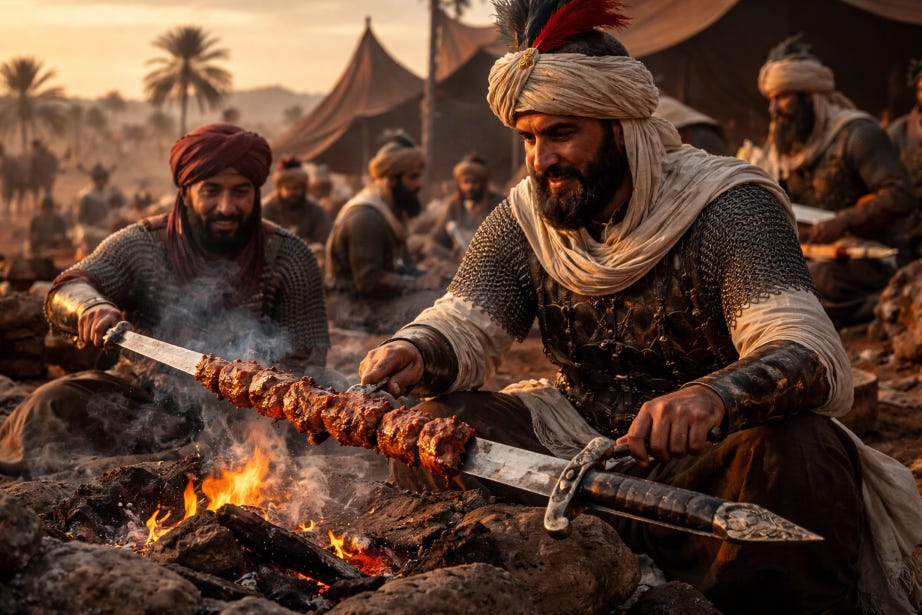
The word itself traces back to the Persian Kabāb, meaning roasted or grilled meat, which feels reassuringly direct. Early forms likely appeared somewhere in the Middle East, where open fires, skewers and hungry people have long coexisted in productive harmony. Soldiers are credited with popularising the concept, skewering meat on swords and cooking it over campfires, which may or may not be historically precise but remains an unbeatable image.
From there, kebabs fanned out across empires and trade routes with the quiet efficiency of a great idea. The Ottomans carried them through Anatolia into southeastern Europe. Merchants and migrants spread them further still. By the time the modern world caught up, the kebab had acquired a passport thick enough to rival that of an airline pilot.
In Turkey, Şiş Kebab refers to cubes of meat grilled on skewers, often lamb, occasionally chicken, always taken seriously. Adana Kebab arrives as a long, hand-minced cylinder of spiced meat clinging to a flat skewer, named after the city that insists it alone understands the correct ratio of fat, heat and seasoning. Döner Kebab rotates majestically on a vertical spit, shaving off crisp edges into bread, wraps or plates with the sort of confidence usually reserved for culinary royalty.
Greece takes the kebab and gives it a sunnier disposition. Souvlaki returns to the skewer, typically smaller pieces of pork or chicken, grilled and served either on the stick or wrapped in pita with tomatoes, onions and a generous application of tzatziki. Then there is Gyros, the Greek cousin of the döner, where vertical spits of layered meat produce crisp, savoury shavings that find their way into warm flatbread.
In Israel, the Kababim are both a staple and a social canvas. Influenced by Middle Eastern, North African and Eastern European traditions, Israeli kebabs often resemble kofta, spiced minced meat grilled on skewers, but the accompaniments tell the broader story. Fresh salads, tahini, pickles and soft pita bread turn the dish into something lively and textured, less about the meat alone and more about the interplay around it. It is casual food, but with a quiet sophistication.
Cross into the Arab world and the names shift again. Shish Taouk offers marinated chicken with a gentle citrus lift, while Kofta trades cubes for minced meat shaped into logs, patties or whatever geometry the cook prefers that day. In Iran, Chelo Kebab elevates the affair with saffron rice, grilled tomatoes and an expectation that this is not street food but a national statement.
India and Pakistan adopt and adapt with characteristic enthusiasm. Seekh Kebab brings spices to the foreground, turning minced meat into something aromatic and unapologetically bold. The tandoor enters the picture, adding both heat and theatre, while regional variations multiply faster than one can keep track of.
The concept began to loosen further, stretch and acquire local personality. Nowhere is this more evident than in the Balkans, where the kebab shed its skewer and reinvented itself as Ćevapi or Ćevapčiči. In Croatia, Serbia and Bosnia, these small, skinless sausages are typically made from a blend of beef, lamb and sometimes pork, grilled hard over charcoal until lightly charred outside and tender within. They arrive in warm flatbread, often with chopped onions, a swipe of Ajvar and occasionally a dollop of Kajmak, a rich, clotted dairy indulgence that behaves like a cross between butter and cream.
Across Russia and the Caucasus, Shashlik takes centre stage, usually larger chunks of marinated meat skewered and grilled over open coals. The marinades lean towards vinegar, onion and pepper, occasionally kefir, giving the meat both tenderness and a faint tang. In Central Asia, variations appear under names such as Mangal or simply skewered meat, often accompanied by flatbreads and raw onion salads that cut through the richness with admirable efficiency.
Eastern Europe, never shy of adapting a good idea, embraces kebab culture in its own pragmatic way. Romania offers Mititei, another close cousin to ćevapi, seasoned with garlic and spices, grilled until aromatic and served without casing. In Bulgaria and neighbouring regions, the lines between kebab, sausage and grilled meat blur further, suggesting that strict definitions were never the point. Then there is Germany’s late-night interpretation, where the kebab becomes both sustenance and social equaliser. There, the Döner Sandwich has achieved cultural citizenship, layered with salad, sauces and a level of engineering usually only seen at a Mercedes factory.
No survey of kebabs would be complete without Southeast Asia’s brilliant contribution – Satay. Smaller, neater and often more politely presented, satay takes the same core idea and refines it with marinades that lean heavily on turmeric, lemongrass, garlic and palm sugar. Originating in Indonesia and spreading across Malaysia, Thailand and Singapore, it swaps the ruggedness of large cuts for thin slices of chicken, beef or lamb, threaded onto slender bamboo sticks and grilled quickly over charcoal. Peanut sauce, rich, slightly sweet, faintly spicy, turns each skewer into a carefully balanced composition.
What makes kebabs endure is flexibility, less a single recipe than a shared language. They tolerate improvisation, reward good ingredients, and scale effortlessly from street corner to white tablecloth. And we would argue they always taste a lot better than an assembly line burger from one of the main brands. How about you?
Image Credit: https://www.churrascophuket.com (AI Generated)
_ _ _
© CHURRASCO PHUKET STEAKHOUSE / ALL RIGHTS RESERVED
Reprinting, reposting & sharing allowed, in exchange for a backlink and credits
Churrasco Phuket Steakhouse serves affordable Wagyu and Black Angus steaks and burgers. We are open daily from 12noon to 11pm at Jungceylon Shopping Center in Patong / Phuket.
We are family-friendly and offer free parking and Wi-Fi for guests. See our menus, reserve your table, find our location, and check all guest reviews here:
https://ChurrascoPhuket.com/
#Churrascophuket #jungceylon #phuketsteakhouse #affordablewagyu #wagyu