
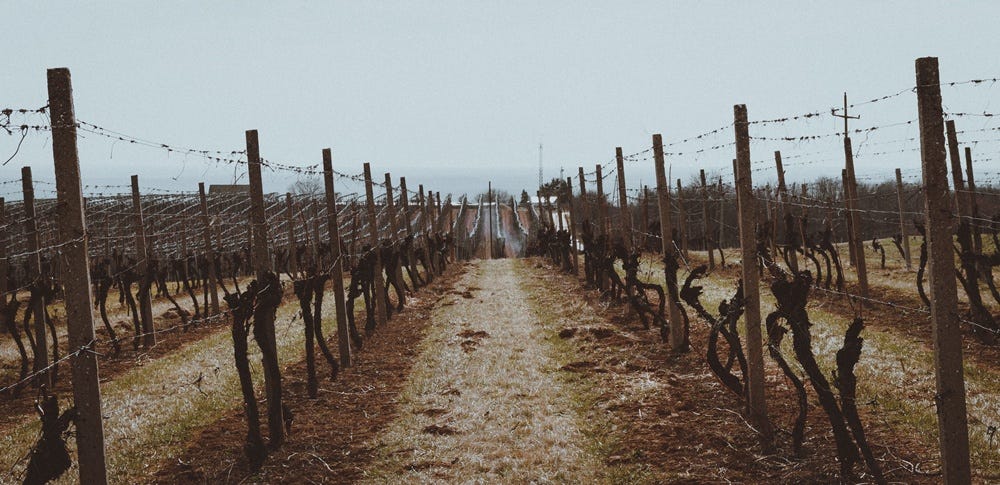
Winemakers do not abandon grapes because they make bad wine, but because they are awkward. They ripen late, yield little, demand explanations, or refuse to charm the drinker in the first ten seconds. In an industry built on recognisable flavour and predictable behaviour, those traits are not endearing, but commercial liabilities. The grapes below survive not because they are easy, but because a handful of growers have decided that difficulty is not a crime.
Red Wine Grapes
Pineau d’Aunis: Loire Valley, France
Pineau d’Aunis is the master of understatement. Pale in colour, it politely lowers expectations and then immediately ignores them. Aromatically it is all white pepper, rose petal, cranberry and savoury tension, behaving far better at the table than its looks would suggest. This is not a wine for analysis paralysis, but a companion to grilled meat, smoke and fat.
Its long standing issue has never been quality but optics. Low yields and modest colour kept it from competing with darker and louder neighbours. Today it survives largely thanks to producers like Domaine Bellivière and Domaine de la Taille aux Loups, who continue to plant it out of belief rather than demand. Pineau d’Aunis is not disappearing yet, but it does require someone to choose it on purpose.
Persan: Savoie and Isère, France
Persan nearly vanished because it asked growers to work harder for less applause. Late ripening, low yielding and structurally serious, it was replaced by more cooperative varieties without much debate. Which is unfortunate, because Persan delivers exactly what mountain vineyards promise but rarely manage. Depth without weight, tannin without aggression, and acidity that understands food.
The modern revival owes much to Domaine des Ardoisières, whose alpine bottlings gave Persan credibility again, and to producers like Domaine Alphonse Grisard, who quietly prove it can age with dignity. Persan now lives in that narrow economic middle ground where conviction matters more than momentum.
Mouhtaro: Central Greece
Mouhtaro is often described as rescued, which is accurate but slightly misleading, because it implies weakness rather than seriousness. In reality, Mouhtaro produces dark fruited, savoury wines with structure and ageing potential. It is neither rustic nor glossy modern, and simply does the job without fuss.
Estate Samartzis has been central in defining its contemporary identity, while Vourvoukeli Estate offers a slightly more polished interpretation. Mouhtaro is not in immediate danger, but its footprint remains tight. Its future depends less on trends and more on sustained interest in indigenous Greek reds.
St Laurent: Austria
St Laurent suffers from being called Pinot Noir’s cousin, which is like describing a dry aged ribeye as a hamburger upgrade. The comparison sets expectations the grape has no intention of meeting. St Laurent is darker, spicier and more brooding, with cherry, cocoa and forest floor notes, and a slightly feral edge in youth.
It is widely planted and entirely secure in Austria, championed by producers such as Heinrich and Johanneshof Reinisch. Its problem is not survival but neglect. Internationally it remains overshadowed by grapes with louder marketing. St Laurent is not disappearing but waiting to be judged on its own terms.
Baga: Bairrada, Portugal
Baga built its reputation during a period when extraction was considered a personality trait. High tannin, high acidity and no interest in early charm made it an easy scapegoat. In capable hands, however, Baga becomes one of Iberia’s most compelling reds. Savoury, structured and quietly long lived.
Luis Pato set the benchmark decades ago, while Filipa Pato has done more than anyone to rehabilitate the grape without sanding off its edges. Bairrada does not function without Baga, and its issue is not survival but lingering prejudice.
White Wine Grapes
Timorasso: Piedmont, Italy
Timorasso should make producers of expensive white Burgundy mildly uncomfortable. Textural, mineral and quietly powerful, it ages effortlessly and performs superbly at the table. Its near extinction now looks like a collective lapse in judgement.
Walter Massa is the reason Timorasso exists in any meaningful way today. Without him, it would likely be a historical footnote. Producers such as Vietti have since helped bring it wider attention. Timorasso is no longer endangered. The risk now is dilution rather than disappearance.
Savagnin: Jura, France
Savagnin is often described as difficult, which is polite shorthand for uninterested in being charming. Whether topped up or oxidative, it delivers umami, grip and structural authority that few white grapes can match. It does not perform but expects you to pay attention.
Domaine Tissot and Domaine Jean Macle continue to define its range and longevity. Savagnin is protected by appellation rules and regional pride. Culturally and legally it is safe, and its only real vulnerability is being misunderstood.
Dry Furmint: Tokaj, Hungary
Furmint is famous but trapped by its success in sweet wine. Dry Furmint is something else entirely. Taut, mineral and transparent to site, it ages with precision and restraint. One of Central Europe’s great white grapes, quietly operating outside the spotlight or influencer babble.
Istvan Szepsy produces reference examples, while Kiralyudvar demonstrates its stylistic range. Furmint is not going anywhere, and Tokaj as a region depends on it. The problem is not survival, but recognition.
Assyrtiko: Mainland Greece
Santorini dominates the narrative, but mainland Assyrtiko deserves equal respect. Linear, saline and precise, it handles heat, smoke and seafood without theatrics.
Gaia Estate and Ktima Gerovassiliou have shown that Assyrtiko does not require volcanic drama to be compelling. The grape is expanding. The risk here is not extinction, but sameness.
Silvaner: Old Vine Germany
Silvaner’s greatest weakness is subtlety. Old vine examples deliver texture, savoury depth and quiet authority, particularly at the table. They do not shout, which in modern wine culture is a strategic error.
Weingut Rudolf May and Weingut Am Stein remain committed advocates. Silvaner as a grape is safe. Old vine Silvaner is less guaranteed, its future resting on whether growers choose patience over replacement.
Final Harvest
Wine grapes survive not because they become famous, but because they are poured, understood and valued. The ones that vanish rarely fail in the glass, and most of these grapes are not dying. They are simply losing the argument at the wine shop shelf. You ca help change that.
Image Credit: https://freepik.com
_ _ _
© CHURRASCO PHUKET STEAKHOUSE / ALL RIGHTS RESERVED
Reprinting, reposting & sharing allowed, in exchange for a backlink and credits
Churrasco Phuket Steakhouse serves affordable Wagyu and Black Angus steaks and burgers. We are open daily from 12noon to 11pm at Jungceylon Shopping Center in Patong / Phuket.
We are family-friendly and offer free parking and Wi-Fi for guests. See our menus, reserve your table, find our location, and check all guest reviews here:
https://ChurrascoPhuket.com/
#Churrascophuket #jungceylon #phuketsteakhouse #affordablewagyu #wagyu
I will right away grasp your rss as I can’t in finding your email subscription link or newsletter service. Do you have any? Please permit me realize in order that I may subscribe. Thanks.
Way cool! Some extremely valid points! I appreciate you writing this write-up and the rest of the website is really good.
Hello! I’ve been reading your web site for some time now and finally got the courage to go ahead and give you a shout out from Lubbock Texas! Just wanted to say keep up the excellent work!
I just couldn’t depart your website before suggesting that I extremely enjoyed the standard info an individual supply in your visitors? Is going to be back steadily to investigate cross-check new posts
There is definately a lot to find out about this topic. I like all of the points you made.
I just could not go away your site before suggesting that I extremely enjoyed the standard information an individual provide for your guests? Is gonna be back incessantly to investigate cross-check new posts
Incredible! This blog looks exactly like my old one! It’s on a entirely different topic but it has pretty much the same layout and design. Wonderful choice of colors!
xmwnqkn cialis dosage for ed zqqekjw