
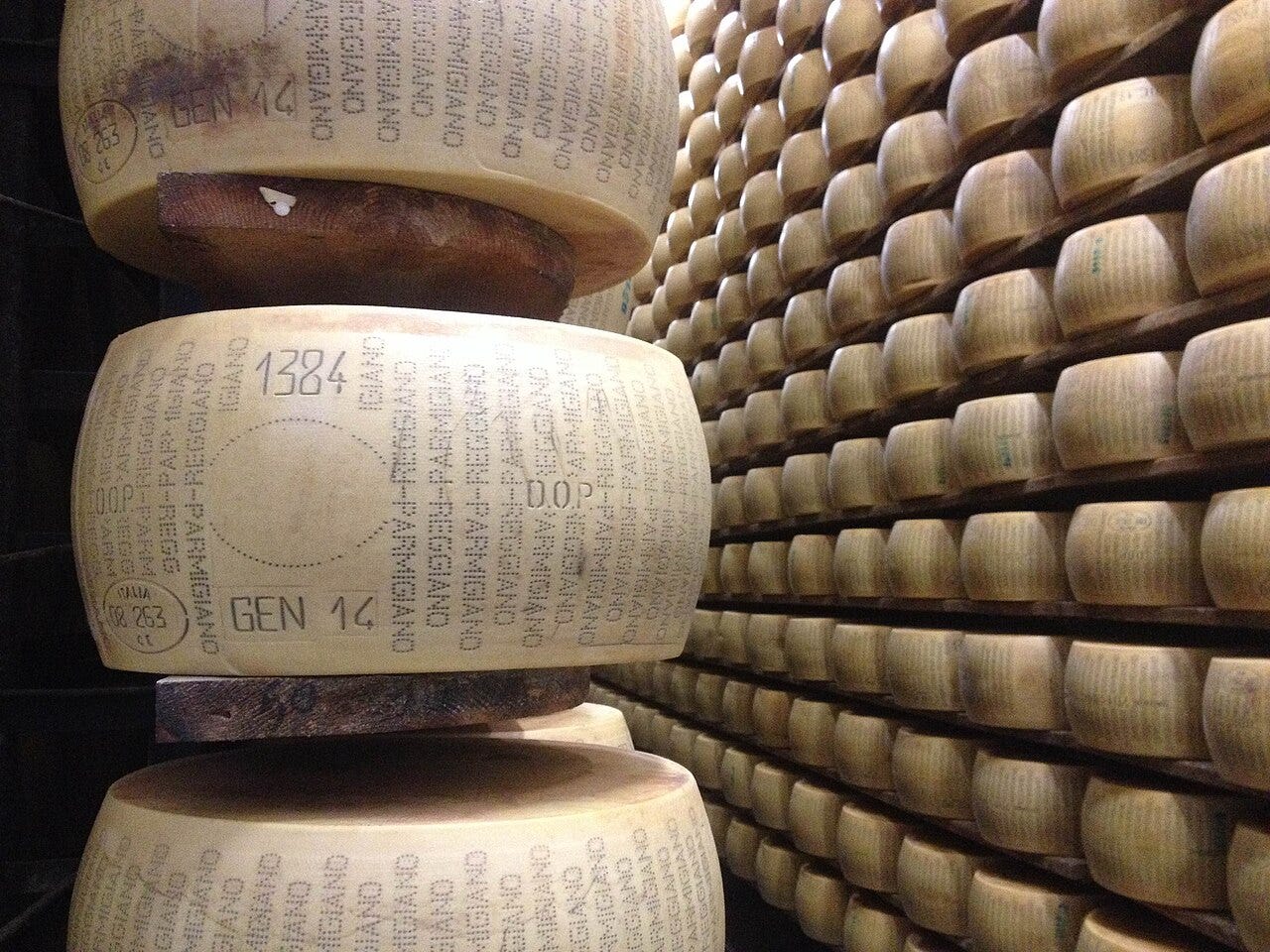
If like me you ever stood in front of the cheese section wondering why one type of Parmesan costs as much as a small holiday, while another sits there looking shy and affordable, you are not alone. The world of Italian hard cheese is full of tradition, rules, and the occasional identity crisis.
So let us take a calm walk through what makes real Parmesan real, why Grana Padano is its no less respectable cousin, and why the word Parmesan can mean very different things to many people, depending on which part of the world you park your shopping trolley.
Real Parmesan?
Within the European Union, there is only one cheese legally allowed to call itself Parmesan, and that is Parmigiano Reggiano. The name is a protected origin designation, which is lawyer speak for “mess with this and you answer to Italy.” True Parmigiano Reggiano can only come from a very specific zone in northern Italy covering Parma, Reggio Emilia, Modena, and carefully drawn parts of Bologna and Mantua.
The recipe is as pure as it gets. Raw milk, salt, and rennet. That is it. No preservatives, shortcuts, or creative additives. The cows are fed grass and hay which sounds idyllic because it is. Absolutely no silage is allowed, a fermented feed that would speed things up but also raise many bushy eyebrows in Italy.
The cheese must mature for at least twelve months, but most of the wheels that achieve greatness sit quietly for twenty four or even thirty six months. Only after passing a strict inspection by the Parmigiano Reggiano consortium does a wheel get the famous branded mark on its rind.
It is cheese with a passport, a security check, and a protected name – but only within the EU. Since a landmark ruling by the European Court of Justice in 2008, Parmesan is considered a clear reference to Parmigiano Reggiano, and therefore protected. So if you buy something called Parmesan anywhere in the EU, it must contain actual Parmigiano Reggiano. No budget imitations, just the real cheese wheel.
Outside the European Union, the story changes dramatically. In the United States, Canada, Australia, and many other places, Parmesan is seen as a generic cheese term somewhat like ketchup or sandwich bread. Not helpful for world peace, but useful when you are shopping in Kansas City or Bondi Beach. The result is a product that is usually industrially made, matures much less, and is allowed to contain additives that would give Italian cheesemakers palpitations and hair loss.
A famous example is the American Parmesan powders that often contain cellulose, which is a polite way of saying wood pulp. It keeps the powder from clumping although the taste effect resembles Parmesan only in the same way that a postcard resembles Venice.
Parmigiano vs. Grana Padano
Both cheeses enjoy protected origin status, and both are beloved Italian hard cheeses. Yet they part ways in three important areas:
Cows’ Diet: Parmigiano Reggiano forbids silage and the cheese contains no preservatives. Grana Padano allows silage which makes production more flexible. As a result, producers must often add lysozyme which is an enzyme from egg white used to keep unwanted bacteria away.
The Region: Grana Padano comes from a much larger area that spans almost the entire Po Valley. That greater scale makes it more available and usually more affordable.
Taste & Time: Parmigiano Reggiano ages longer and develops more complex flavours and that crumbly crystal texture loved by cheese enthusiasts. Grana Padano matures for a shorter period starting at nine months and tastes milder and more buttery. It is the cheese you choose when you want character but not a full flavour assault.
Maturity Levels
Parmigiano Reggiano has four notable stages, and even uses coloured labels to guide the shopper. Twelve to nineteen months known as Delicato, still soft for a hard cheese with a milky profile. It works well as a snack, especially if you want to look sophisticated without breaking a tooth. Twenty to twenty six months is the Classic range, which shows the first real crumble and fruit notes, while twenty-two months offers balance between sweet and savoury.
Thirty to thirty nine months is called Aromatico, or “the golden label”. It is very crumbly and intensely savoury. Ideal with a drizzle of balsamic and a moment of “me-time” away from the kids. Over forty months is for the committed cheese fans. Darker, drier, sandy in texture and packed with layers of aroma from leather to mushroom to a hint of smoke. This is a cheese that has seen and heard many things.
Grana Padano offers three official stages. Nine to sixteen months is mild, creamy, pale, and easy going. A friendly cheese that melts beautifully and never argues back. Over sixteen months begins to show the classic grainy structure. Flavour becomes more pronounced but remains smooth. A very good kitchen all rounder. Over twenty months called Riserva has more crystals, more depth, and a fuller flavour that brings it closer to Parmesan. People often enjoy it on its own which tells you everything.
The Choice
The longer the cheese matures, the less water it holds. That means it gets drier, firmer, saltier, and packed with flavour. The little white protein crystals that crunch pleasantly are not flaws. They are nature’s way of saying you chose well. In short, not all Parmesan is created equal. Some cheeses are ambassadors of centuries of craft. Others come with a faint whiff of a sawmill.
Choose wisely, and your pasta and restaurant guests will love you.
Image Credit: https://www.wikipedia.org
_ _ _
© CHURRASCO PHUKET STEAKHOUSE / ALL RIGHTS RESERVED
Reprinting, reposting & sharing allowed, in exchange for a backlink and credits
Churrasco Phuket Steakhouse serves affordable Wagyu and Black Angus steaks and burgers. We are open daily from 12noon to 11pm at Jungceylon Shopping Center in Patong / Phuket.
We are family-friendly and offer free parking and Wi-Fi for guests. See our menus, reserve your table, find our location, and check all guest reviews here:
https://ChurrascoPhuket.com/
#Churrascophuket #jungceylon #phuketsteakhouse #affordablewagyu #wagyu
Everyone loves it when individuals come together and share opinions. Great website, stick with it!
I am sure this post has touched all the internet people, its really really fastidious paragraph on building up new webpage.
I will right away snatch your rss feed as I can not to find your email subscription link or e-newsletter service. Do you’ve any? Please allow me know in order that I may subscribe. Thanks.
What’s up, I check your blog like every week. Your writing style is awesome, keep up the good work!
I’ll right away snatch your rss as I can’t find your email subscription hyperlink or newsletter service. Do you have any? Kindly let me realize so that I may just subscribe. Thanks.