
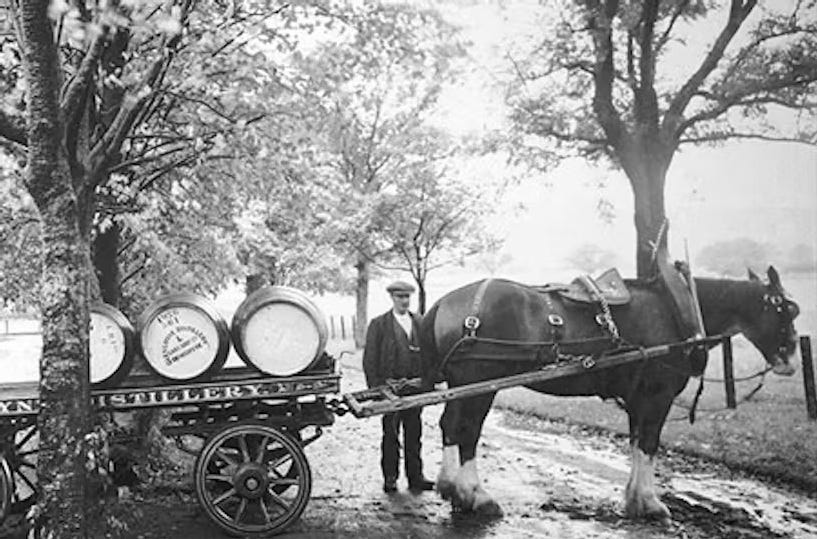
Fine Scotch whisky tends to inspire reverence. For many, it is less a beverage and more a cultural artefact – swirled slowly, discussed seriously, and occasionally defended with the kind of passion usually reserved for national football teams. Yet its history is far more grounded than the myths that surround it. Scotch wasn’t born in a lightning bolt of genius, or handed down by ancient Highland sages who gazed into the mist, whispered a spell, and conjured liquid gold into being. It was built patiently over centuries by farmers, monks, smugglers, tinkerers, and later by the sort of industrial minds who believed good things should be made at scale.
Friar Cor and the Fiery Beginning
The first written mention arrives in 1494, tucked into Scotland’s Exchequer Rolls, where King James the Fourth supplied Friar John Cor with enough barley to produce aqua vitae. That early spirit – though admirable for its time – bore little resemblance to what we sip today. It was strong, sharp, and decidedly un-aged. A drink taken more out of necessity or remedy than leisurely indulgence. Nobody was nosing for hints of honey or lingering finish. Survival, not sophistication, defined the era.
Distillation Arrives by Way of Europe
Few Scots will admit that Scotland didn’t actually invent distillation. The practice travelled through Europe courtesy of monks, physicians, and alchemists, who were often pursuing medicine rather than merriment. In rural Scotland, distilling became part of agricultural life, a practical way to convert surplus grain into something preserved and portable. These early makers weren’t thinking about terroir or brand identity. They were simply ensuring that good grain was converted into something valuable, drinkable, and dangerously flammable. The artistry we associate with whisky today would take centuries to emerge.
Oak Casks: The Happy Accident
Modern whisky lovers speak of cask influence with deep respect, but those early distillers did not lovingly select oak for its flavour properties. Nobody expected them to impart flavours of vanilla, toast, and gentle smugness. Oak was durable, abundant, and useful for transport. Yet over time, it revealed itself as a quiet craftsman. Spirit stored in oak softened, deepened, and transformed. The magic only became apparent over time, when spirit went into the cask angry and came out surprisingly pleasant. What started as a logistical solution became an integral part of the craft. Generations of distillers refined the practice, turning accident into tradition and tradition into standard.
The Illicit Years: Creativity Faces The Taxman
By the seventeenth and eighteenth centuries, taxation had become a defining force. Heavy duties made legal production nearly impossible for small-scale distillers, and so they adapted. Illicit stills dotted the landscape, operated with ingenuity and discretion. Quality ranged from rough to excellent, depending on who was running the still and how much haste was involved. Some was excellent, others could strip paint. These whiskies were almost always young, for obvious reasons. A cask left to slumber for a decade risked being discovered long before it became drinkable.
1823: The Year Scotch Went Respectable
The Excise Act of 1823 marked the great turning point. Suddenly, legal distillation became not only possible but sensible. A reasonable licence fee and more practical duties encouraged distillers to step into the light. With legality came stability. With stability came investment. Better equipment, longer ageing, and consistent practices took root. Scotch whisky began its steady march from rustic firewater to refined national treasure. Think of it as the moment the whisky industry collectively put on a clean shirt and decided to stop running from the authorities.
Innovation Arrives: The Coffey Still
In 1830, Aeneas Coffey patented his continuous still, a piece of engineering that changed production forever. It allowed for cleaner, lighter grain spirit to be produced at scale. When blended with traditional malt whisky, it created a balanced, approachable style that suited global markets. Rather than replacing the pot still, the Coffey still broadened the palette. Scotch could now be nuanced in more ways, its character shaped by blending as much as by place. Even better, it could be produced in quantities large enough to satisfy the ever-thirsty British Empire. Blended Scotch was practical, scalable, and still tasted recognisably Scottish.
Blends Conquer the World
Blended Scotch did not triumph through romance but through human stubbornness. It was consistent, versatile, and far easier to produce in the quantities needed abroad. The combination of malt complexity and grain elegance created something both distinctive and accessible. And perhaps that is its true charm. Every sip is a reminder that great things often come from imperfect beginnings. Blended Scotch became the global ambassador for the craft, opening the doors that single malts would later walk through proudly.
The Final Dram
Let us always remember that Scotch whisky did not arrive fully formed. It evolved, stumbled, improved, and eventually triumphed. Its romance lies not in legend but in truth. Its history honours the many hands that shaped it, from monks and farmers to modern distillers who continue the work with both discipline and pride. A reminder that great crafts are not invented, but earned over time.
Image Credit: https://www.glengoyne.com/our-way/our-legacy
_ _ _
© CHURRASCO PHUKET STEAKHOUSE / ALL RIGHTS RESERVED
Reprinting, reposting & sharing allowed, in exchange for a backlink and credits
Churrasco Phuket Steakhouse serves affordable Wagyu and Black Angus steaks and burgers. We are open daily from 12noon to 11pm at Jungceylon Shopping Center in Patong / Phuket.
We are family-friendly and offer free parking and Wi-Fi for guests. See our menus, reserve your table, find our location, and check all guest reviews here:
https://ChurrascoPhuket.com/
#Churrascophuket #jungceylon #phuketsteakhouse #affordablewagyu #wagyu
Your article helped me a lot, is there any more related content? Thanks!
Excellent site. Plenty of helpful information here.
I’m sending it to some pals ans additionally sharing in delicious.
And of course, thank you for your sweat! http://Www.dunklesauge.de/topsite/index.php?a=stats&u=karine19u4
I simply could not leave your site before suggesting that I extremely enjoyed the usual info a person provide to your guests? Is gonna be back frequently in order to inspect new posts
I like what you guys are usually up too. This kind of clever work and reporting! Keep up the great works guys I’ve incorporated you guys to my blogroll.
I don’t think the title of your article matches the content lol. Just kidding, mainly because I had some doubts after reading the article. https://accounts.binance.info/pt-BR/register-person?ref=GJY4VW8W
There is certainly a lot to know about this subject. I really like all of the points you made.
It’s very straightforward to find out any topic on net as compared to textbooks, as I found this post at this web site.